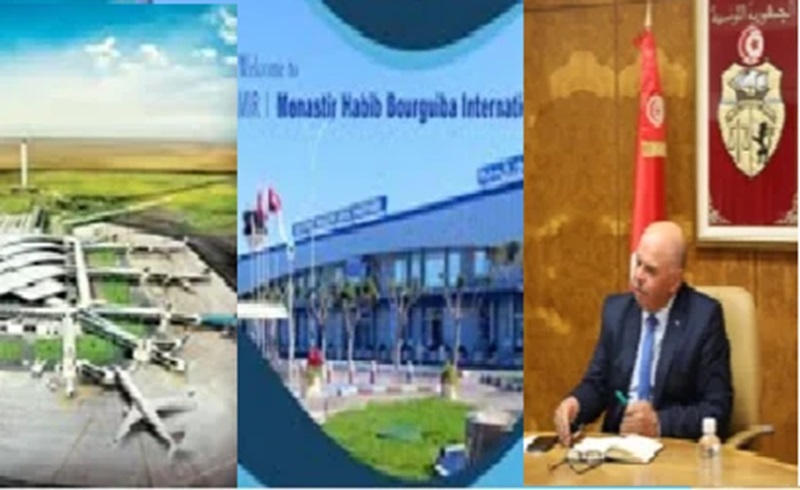
In his response to a question from MP Halim Boussema regarding the creation of a new airport outside the capital, alongside the restructuring and expansion of Tunis-Carthage International Airport—Tunisia’s Minister of Transport Rachid Amri stated that:
“The Civil Aviation and Airports Authority has begun preparing a project file to expand the airport to a capacity of 18.5 million passengers per year, with the possibility of increasing this capacity in later phases depending on passenger traffic growth.”
The minister’s reply also included an important clarification, both for Tunisia’s economic relations with France and Turkey. Speaking about the expansion of Tunis-Carthage, Amri explained that:
“This will allow the Authority to continue operating Tunis-Carthage Airport until 2050 and beyond, knowing that the contractual concession period of Enfidha Airport expires in 2047.
This requires considering the possibility of taking it back after the contract expires, and linking it to Tunis-Carthage Airport via a high-speed train, in order to strengthen the Authority’s and the airports’ capacity to absorb air-traffic growth and the rising number of passengers. Consequently, the proposal to build a new airport has been definitively abandoned for now.”
Local media, however, chose to translate the Arabic term “استعادته”, which clearly means “recovery” or “takeover”, as “reactivation.”
It remains to be seen whether this is merely a maneuver by the Ministry of Transport aimed at reassessing the price of the concession, the official value of which has never been publicly disclosed and has long been a point of dispute between Tunisian and Turkish stakeholders, with the latter repeatedly voicing complaints.
It should be noted that Enfidha-Hammamet Airport and Monastir Airport have been operated since December 2009 by a company jointly owned by the Turkish group TAV and the French group ADP (Aéroports de Paris) through TAV Tunisia.
The Tunisian state remains the owner of the infrastructure, while the concession grants usage rights, allowing TAV to manage airport services, duty-free zones, and the commercial operations of the two airports.
“A patchwork solution,” says MP Boussema
Commenting on Minister Amri’s response, MP Halim Boussema considered the ministry’s proposed solution “clearly insufficient.” The plan consists initially of leasing two aircraft, followed by four additional ones between 2027 and 2030.
According to the MP: “Such a measure cannot in any way be considered a serious rescue plan for an airline.”
In his view: “A temporary aircraft-leasing policy, without radical and simultaneous reform of governance, management, the debt structure and the operational model of Tunisair, will produce only one result: further waste of public funds, with no prospect of restoring lost competitiveness.”
In conclusion, the MP issued a solemn call to decision-makers for “a courageous and visionary strategic decision capable of fundamentally reshaping Tunisia’s national air-transport landscape for the coming decades, rather than relying on short-term fixes managed day by day.”
Aircraft leasing plan 2026–2030
The “patchwork measures” mentioned by the MP are already included by the minister within the restructuring plan for 2026–2030, which provides for an international tender for the long-term dry lease (6 years) of two Airbus A320 aircraft in 2026 and the leasing of four medium-capacity aircraft and two large-capacity aircraft between 2027 and 2030.
Observers question whether such steps will truly revive the national airline, or whether the government will even have the financial means to sustain the plan.
Meanwhile, the ministry—without specifying sources of financing, continues to speak of a “marketing roadmap for airports,” synergies between the different sectors involved and a contact committee tasked with organizing a series of meetings.”
After reviewing the minister’s official response to his written question, MP Boussema reiterated that it merely confirmed that authorities are persisting in a “patchwork policy” rather than implementing genuine structural reform.
According to him, instead of presenting a strategic roadmap capable of rebuilding Tunisia’s air-transport sector on modern and competitive economic foundations, the minister merely justified a Council of Ministers decision.
He concluded: “Limiting ourselves to a facelift of Carthage Airport is condemning Tunisia to endure its delay rather than overcome it.”
TAV Tunisia: “No comment”
Contacted by Africanmanager regarding the minister’s statements, Emilie Lefebvre, CEO of the Franco-Turkish airport operator, replied: “We have no comments to make on this matter. We simply recall that TAV Tunisia, under the concession granted to it until 2047, continues to operate the Enfidha-Hammamet and Monastir airports with the utmost rigor and in full compliance with the most demanding international standards.”
She added: “These modern infrastructures are major assets for the development of tourism and the national economy. In this respect, TAV Tunisia shares with all sector professionals the desire to identify and remove obstacles that may still limit their full utilization.”
The issue of ground connectivity, she noted, is regularly raised in this context: “We welcome the attention given by the relevant authorities to this matter and remain convinced that collective mobilization will make it possible to fully leverage the airport capacities already available in the service of Tunisia.”
Political question marks
Why make such declarations more than 20 years before the concession expires?
Why provoke what could be described as a multi-billion-dinar shake-up in the sector?
Is it populism? Does the ministry actually have the means to implement such a policy?
Only time will tell.