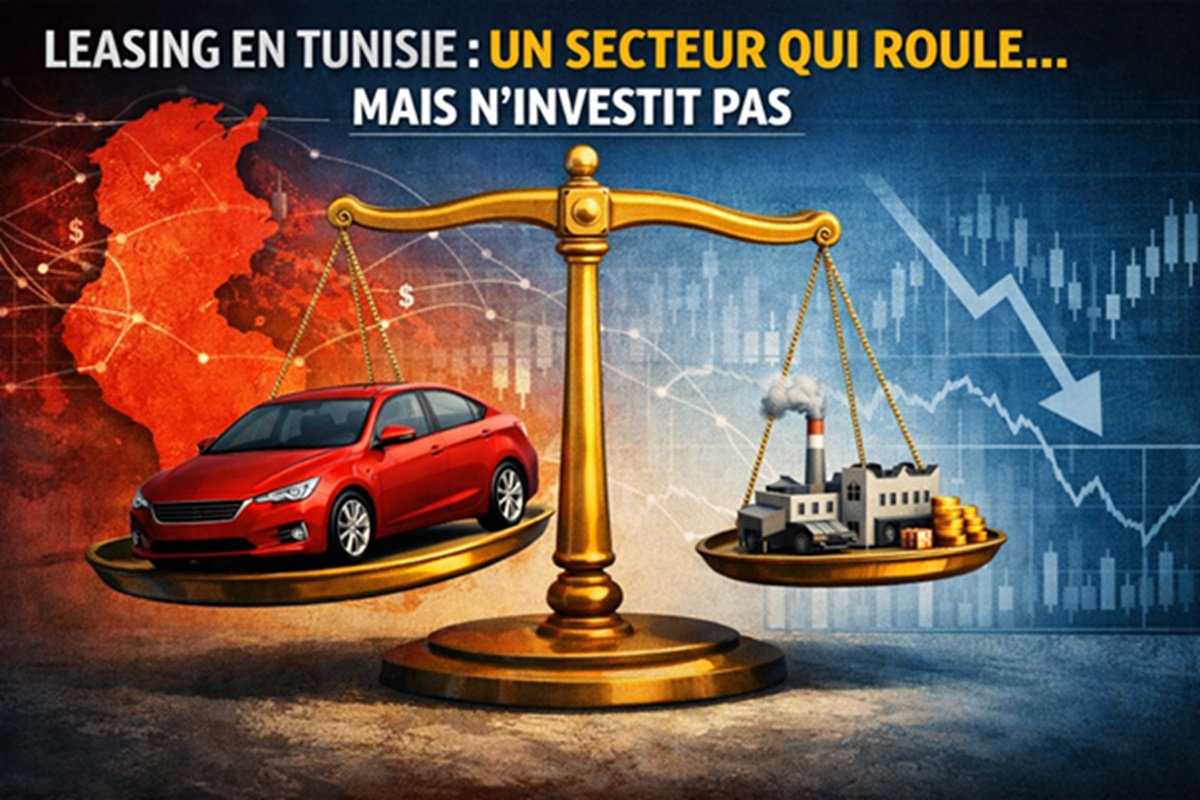
A recent report by Mac SA on Tunisia’s leasing sector highlights a striking figure: 80% of financing is directed toward rolling stock. This means that four out of every five dinars financed through leasing are used for vehicles, cars, utility vehicles, and transport equipment. The figure stands out as significantly higher than in more mature leasing markets.
Leasing in Tunisia: Profitability under pressure in 2025
Despite seemingly resilient headline figures, Tunisia’s leasing sector ended 2025 with financial performance indicators under strain. Rising operating costs and deteriorating client risk have put pressure on the sector’s business model.
An analysis shows declining operational efficiency, with financial performance caught in a squeeze effect. While gross operating income rose by 8.5% in 2025, operating expenses increased faster, by 9.5%. This gap reflects companies’ inability to absorb fixed costs. According to the Mac SA report, this trend is partly linked to Law No. 2025-9 on employment contracts, which required restructuring staff-related expenses and temporarily increased operational costs.
The “automotive growth” paradox
Although production grew by 6.2%, this was deemed insufficient to significantly boost outstanding volumes. More importantly, the growth rests on a fragile foundation: rolling stock, which now accounts for 75% to 80% of new financing.
This heavy dependence on the automotive segment weakens commercial performance, as leasing companies are increasingly exposed to supply constraints affecting the automotive industry. In effect, financial performance depends less on leasing companies’ sales efforts and more on vehicle availability at dealerships.
Risk costs: The weight of structural challenges
Net profitability is also threatened by portfolio quality. Classified commitments rose by 4.1% to 434.2 million dinars. The sector continues to face structural difficulties, particularly in sectors such as construction and public works.
Payment discipline has also been affected, notably by new cheque regulations. With a non-performing loan ratio of 8.8%, the sector faces regulatory pressure, as the Central Bank of Tunisia aims to bring this ratio below 7% by 2026.
The burden of refinancing
Performance is further weighed down by the high cost of funding. The average lending rate reached 14.98%. Unlike banks, leasing companies do not have direct access to refinancing facilities from the Central Bank of Tunisia, forcing them to rely on more expensive market funding. This also exposes them to high hedging costs for foreign currency risk on international credit lines.
Limited visibility weighs on market perception
Despite attractive valuations and generally stable fundamentals, leasing stocks remain under pressure on the stock market due to limited visibility on growth prospects and low liquidity.
Analysts believe that while the sector managed to hold up in 2025, its financial performance reflects a sector losing momentum. Its long-term sustainability now depends on a recovery in gross fixed capital formation, seen as essential for restoring productive and healthy financing.
A mobility sector rather than a production driver
A deeper reading of the data suggests that leasing in Tunisia is primarily tied to mobility rather than production. Instead of acting as a lever for productive investment, it mainly supports consumption and fleet renewal rather than industrial modernization.
This reveals a structural imbalance. In an economy seeking to move up the value chain, greater financing of machinery, industrial equipment and technology would be expected. The 80% figure is therefore more than just a statistic, it is a diagnosis of a sector financing wheels rather than factories.
Vulnerability to domestic economic shocks
The dominance of vehicle financing also exposes the sector to economic cycles. A slowdown in vehicle imports, tighter credit conditions, or a decline in purchasing power could quickly impact leasing activity.
Industry perspective
Professionals acknowledge that vehicle leasing, including car rental, accounts for 10% to 20% of new financing. They also confirm lower financing of productive assets, attributing this to generally weak investment levels in the country.
They argue that vehicles represent lower risk, particularly given recent changes in cheque regulations and lengthy legal procedures for asset recovery.
At the same time, they note that refinancing conditions remain relatively smooth for now, as the state is placing less pressure on banking liquidity thanks to direct borrowing from the Central Bank.