There is one way to read Tunisia’s 2025 budget figures that makes you want to applaud. The deficit has narrowed. Tax revenues have increased. Debt has slightly declined as a share of GDP. It looks good on paper.
But there is another way to read them: through the eyes of ordinary citizens doing their shopping, paying their bills, and wondering why everything costs more. That reading is far less flattering, yet probably the correct one.
The tax system: an endless extraction machine
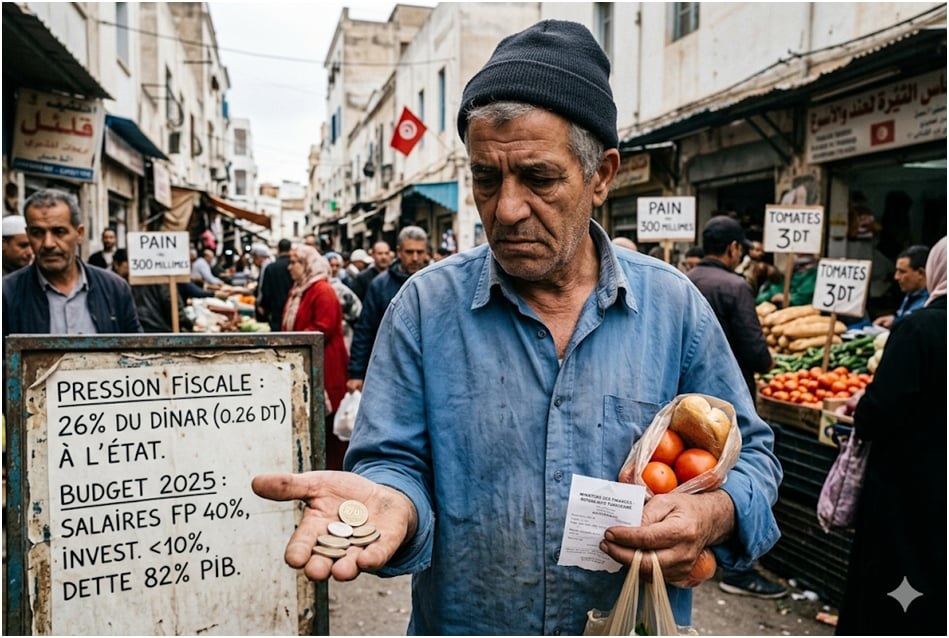
Tunisia’s tax revenues reached 44.75 billion dinars in 2025, up 7.3% year-on-year. The tax burden now stands at 25.9% of GDP. In practical terms, this means that for every dinar of wealth created in the country, nearly 26 millimes go directly to the state before companies even pay suppliers, employees, or investments.
What is striking is not the increase itself, but what lies behind it. VAT revenues rose to 11.72 billion dinars, up 4.2%. Excise duties climbed 6.4% to 4.24 billion dinars. Customs duties jumped 10% to 2.28 billion dinars. Together, these three categories account for over 40% of total tax revenues and all are ultimately passed on to consumers through higher prices.
While official inflation stood at 5% year-on-year in March 2026, according to Tunisia’s Central Bank, the state continued increasing indirect taxation. The result is straightforward: higher customs duties raise the price of imported goods, while higher excise taxes increase the cost of fuel, beverages and manufactured products. The argument is that the state is not fighting inflation — it is helping fuel it.
Corporate tax: the budget’s winner, the consumer’s loser
Corporate tax revenues from non-oil companies surged 32.6% in 2025 to 5.51 billion dinars. The Ministry of Finance presents this as proof of private-sector vitality. Critics argue otherwise: when companies pay more taxes, they either absorb the cost through lower profit margins or pass it on through higher prices. In a market with weak competition, consumers usually end up paying.
Meanwhile, corporate taxes from oil companies fell 21.2% to just under 1 billion dinars. As energy revenues decline, the shortfall is increasingly compensated through taxes affecting households.
Salaries consume the budget
Total state spending reached 58.47 billion dinars in 2025. Public-sector wages alone absorbed 23.28 billion dinars, nearly 40% of total expenditure. Almost two out of every five dinars spent by the state go to paying public employees.
Transfers and subsidies added another 20.15 billion dinars, while debt interest payments amounted to 6.46 billion dinars, or 11% of total spending. Together, these three categories make up 85% of the budget.
Investment: the neglected priority
Public investment spending reached only 5.73 billion dinars in 2025, or 9.8% of total expenditure. Less than 10% of state spending goes toward roads, hospitals, digital infrastructure, or productive investments.
The comparison is stark: for every dinar invested in the country’s future, the state spends four paying current wages. Critics say this reflects a public administration increasingly focused on sustaining itself rather than driving development.
Debt: a burden carried across generations
Public debt stood at 141.67 billion dinars in 2025, equivalent to 82.1% of GDP, down slightly from 84.9% in 2024. Yet debt interest payments alone cost 6.46 billion dinars, about 13% of all budget revenues. In other words, one out of every eight dinars collected by the state goes solely to servicing debt.
To finance its 8.98-billion-dinar deficit, Tunisia borrowed 25.64 billion dinars in 2025, with over 83% sourced from the domestic market. Economists warn this crowds out private-sector borrowing by absorbing available bank liquidity and making credit more expensive for businesses.
The Tunisian paradox
The state spent 11.59 billion dinars on subsidies, including 7.63 billion dinars for fuel alone. Subsidies are presented as social protection, but critics argue they also reflect a vicious cycle: the state taxes production and consumption, pushing prices higher, then subsidizes some prices to soften the impact, borrows to finance those subsidies, and later raises taxes again to repay the debt.
On paper, Tunisia’s 2025 budget appears to improve: the deficit narrows, debt ratios edge down, and revenues rise. But many Tunisians still face higher living costs, stagnant purchasing power, and an economy where the burden increasingly falls on consumers.