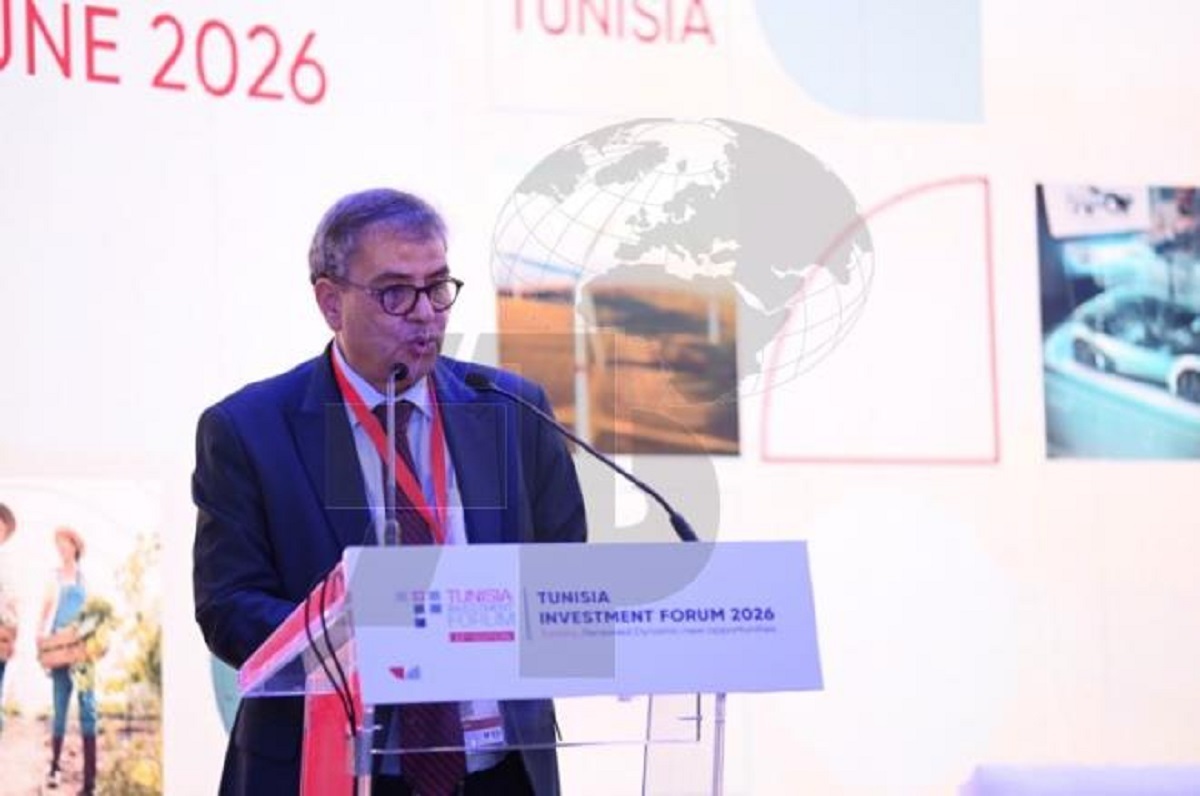
The results achieved by the Tunisian economy in recent years represent significant gains, but they remain under constant scrutiny in an international environment marked by uncertainty and multiplying shocks.
More than a statement of satisfaction from the Governor of the Central Bank of Tunisia (BCT), it should be seen as a call not to let down our guard regarding inflation, the exchange rate, foreign currency reserves, and certain sources of external vulnerability in order to preserve economic and financial stability.
Speaking at the 22nd edition of the Tunisia Investment Forum (TIF), Fethi Zouhaier Nouri said that “this restored stability constitutes an essential foundation of visibility for economic actors, but it must now be strengthened through accelerated reforms.”
He stressed that maintaining this trend depends on growth being increasingly driven by productive investment, exports, and non-debt-creating capital inflows, particularly foreign direct investment (FDI).
“These results are not merely macroeconomic indicators; they are signals sent to the investment community. Beyond sectoral opportunities, investors are above all seeking stability, predictability, respect for commitments, and strong institutions,” the BCT Governor stated, adding that Tunisia has demonstrated its ability to withstand turbulence.
“Tunisia has honored all of its external financial commitments on time, thereby preserving its credibility with partners and markets,” he said. He added that yields on Tunisian bonds in international markets have improved significantly, following a marked downward trend since 2024, reaching around 7% during the first five months of 2026, compared with over 30% in 2023.
Tunisia’s credibility is being rebuilt
“The improvement in Tunisia’s sovereign rating is also a strong signal that our country’s credibility is being rebuilt on solid foundations,” Nouri said, noting that Tunisia has entered a phase of net external deleveraging since 2023.
“The stock of long-term external debt declined from 82 billion dinars to 68 billion dinars in 2022, representing a contraction of nearly 18%,” he stated. According to him, this dynamic reflects an improvement in external sustainability, reduced dependence on international markets, and a gradual rebalancing of Tunisia’s external financing model.
For Nouri, restored stability is not an end in itself but rather the foundation for a new phase focused on investment, wealth creation, and accelerated growth.
“Competitiveness cannot simply be decreed; it is built through courageous reforms, a more efficient administration, better infrastructure, greater energy availability, and renewed trust among all economic stakeholders,” the BCT Governor said.
Regarding investment, which he described as the key to all economic transformation, Nouri argued that it should not be approached solely from a regulatory perspective, such as investment codes, tax incentives, or the business climate.
“These reforms are indispensable, but they are not enough. The real challenge for an economy like Tunisia’s is to build a society where investing becomes a reflex, where wealth creation is seen as a legitimate ambition, and where every young Tunisian views entrepreneurship as a vocation. Before being a financial flow, investment is a state of mind,” he explained.
Addressing Tunisian business leaders and entrepreneurs, Nouri stressed that the first signal of confidence in the Tunisian economy must come from Tunisians themselves.
Rejecting a Wait-and-See Attitude
He called on local investors to leave behind “wait-and-see attitudes,” warning that such behavior reflects a lack of confidence that can become structural if no coordinated action is taken.
“In times of uncertainty, caution is legitimate. But when caution turns into paralysis, it ultimately costs both businesses and the economy,” he emphasized.
Nouri also highlighted Tunisia’s attractiveness to foreign investors, recalling that in 2025 foreign direct investment exceeded 3.5 billion dinars, up more than 30% year-on-year and surpassing the country’s target.
“Excluding the energy sector, these flows resulted in 921 operations and the creation of more than 14,000 jobs,” he noted. He added that Tunisia now hosts more than 280 automotive component manufacturing units, several of which have established their own research and development centers.
Future-oriented sectors are also finding fertile ground in Tunisia, including renewable energy, the digital economy, and artificial intelligence. Likewise, startups represent one of the most promising drivers of the new investment dynamic, demonstrating that Tunisia is no longer exporting only goods and services, but also ideas, innovation, and technological solutions, Nouri concluded, recalling that Tunisia was among the first African countries to adopt a dedicated legal framework for startups through the Startup Act.