The summer of 2026 was supposed to be the summer of relief. Reservoirs were full, desalination plants were inaugurated with great fanfare and new solar farms were connected to the grid.
Yet just six months later, both water and electricity are still being cut off and the blame game has become almost absurd. SONEDE points the finger at STEG, STEG blames air conditioners and the officials who celebrated their achievements in the spring have quietly disappeared from the spotlight.
The great blame game
Let’s begin with the scene as it is unfolding.
Mounir Dridi, SONEDE’s regional director for Greater Tunis, says that water outages are mainly caused by electricity cuts, since pumping stations cannot operate without power. A perfectly logical explanation. The problem, he suggests, lies next door.
STEG has a different story. Its CEO, Faisal Trifa, attributes power outages to soaring air-conditioning use.
According to him, electricity demand during peak hours, between 2 p.m. and 4 p.m., reaches 5,000 megawatts, about 30% above normal levels. In other words, if the lights go out, it’s because Tunisians dare to switch on their air conditioners in July, when temperatures exceed 40°C.
Yet in the very same statement on July 15, Trifa reveals more than he may have intended. He acknowledges that STEG resorts to preventive load shedding to avoid a nationwide blackout, effectively admitting that the utility deliberately cuts power because the system lacks sufficient capacity.
He also concedes that electricity imports from Algeria were very limited, as Algeria was facing the same heatwave. With one hand he blames air conditioners; with the other, he admits Tunisia’s dependence on imported electricity.
It is a remarkable example of public-sector crisis management. Everyone acknowledges the problem, yet no one accepts responsibility. Water blames electricity. Electricity blames consumers and Algeria. Consumers blame their utility bills. The blame keeps circulating, while the only real loser is the citizen left without either water or electricity.
What we were promised six months ago
The irony lies in the official promises made earlier this year, all documented and all optimistic.
On water resources, Faiez Moslem, Director General of Dams at the Ministry of Agriculture, described the situation on June 23, 2026, as “very reassuring,” saying reservoirs were 60% full, enough to meet summer demand.
As early as May, reports suggested Tunisia would experience its first summer in years without widespread water restrictions. Reservoirs in Cap Bon were nearing 98% capacity. On paper, the drought had been overcome.
Desalination was presented as an even bigger success story. On June 18, 2026, Agriculture Minister Ezzedine Ben Cheikh personally inaugurated the Sfax desalination plant, financed through a Japanese loan of roughly 800 million dinars, with a production capacity of 100,000 cubic meters per day. SONEDE CEO Abdelhamid Mnaja announced that the Sousse desalination plant would come online at the beginning of summer. Together with the Zarat plant, operating since late 2024, and the Djerba plant, in service since 2018, Tunisia was expected to have three operational desalination plants, while Sousse remained a promise on the calendar.
National desalination capacity was projected to reach 370,000 cubic meters per day, about 15% of national demand. The message was clear: summer water shortages would soon become a thing of the past.
Electricity followed the same optimistic narrative. The very same Faisal Trifa, who now blames air conditioners, inaugurated Tunisia’s largest solar power plant in Kairouan in December 2025, presenting it as a major boost to the national grid with more than 100 MW of capacity.
Additional 60 MW solar plants in Tozeur and Sidi Bouzid followed in April 2026. Then-Industry Minister Fatma Thabet Chiboub even declared, without irony: “Imagine a day without electricity, it’s impossible!” Today, many Tunisians no longer have to imagine it.
The sum of the promises, the difference in reality
Let’s add up the numbers: reservoirs at 60% capacity, three desalination plants in operation and more than 220 MW of new solar generation added in just four months. Yet water still stops flowing, and electricity still goes out. How?
The answer is uncomfortable.
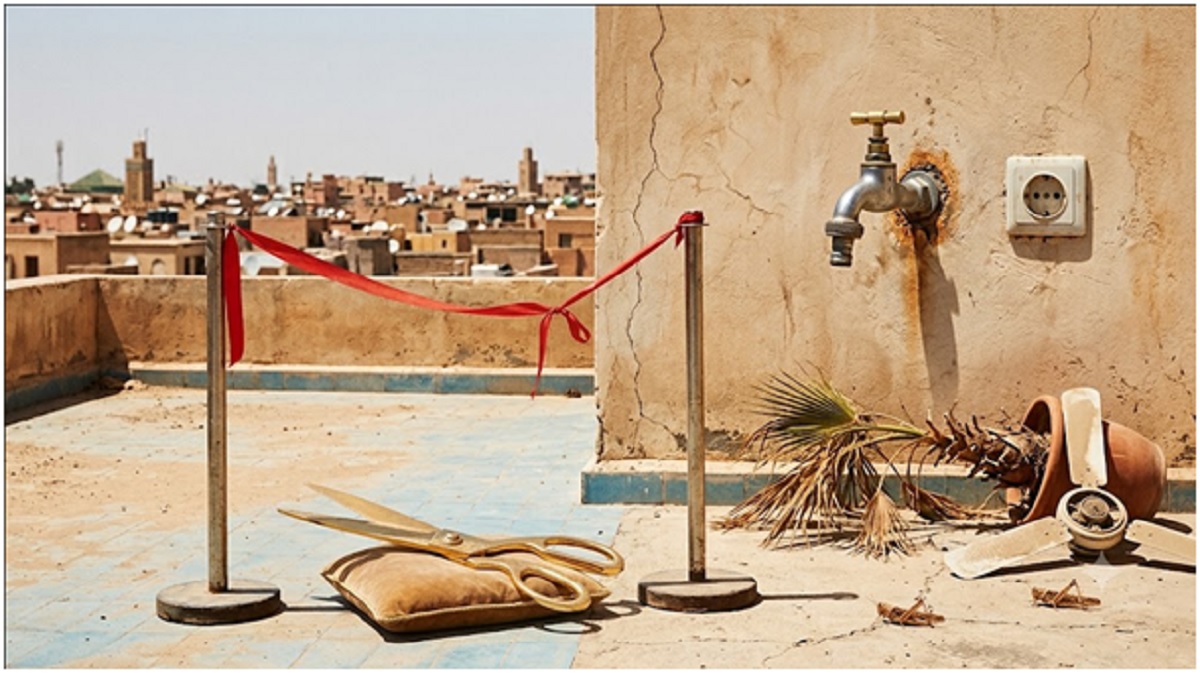
A full reservoir is useless if pumping stations have no electricity. An inaugurated desalination plant is not necessarily operating at full capacity; there is often a long period between the ribbon-cutting ceremony and full commercial output. As for solar power, the argument raises another question.
The peak demand identified by Trifa occurs between 2 p.m. and 4 p.m., precisely when solar panels generate the most electricity. If the grid still fails during those hours despite an additional 220 MW of solar capacity, then the problem is not a lack of sunshine but the grid’s inability to transmit and distribute the available electricity.
Moreover, solar energy still accounts for only about 4% to 9% of Tunisia’s electricity mix, far below the 35% target set for 2035.
The inaugurations were real. The advertised capacities, however, often reflected brochure figures rather than operational reality. Public communication advanced faster than concrete and transmission lines.
The one number that doesn’t lie
One statistic receives remarkably little attention.
Desalinated water costs roughly three dinars per cubic meter, around three times more than water supplied from reservoirs, while SONEDE reportedly sells it for about 200 millimes per cubic meter, contributing to a deficit that is said to exceed 860 million dinars.
Meanwhile, as STEG blames air conditioners, Tunisia’s parliament approved two World Bank loan guarantees on July 14 specifically aimed at improving the efficiency and governance of the country’s energy sector.
That approval amounts to a quiet admission: if the power grid were functioning as it should, there would be no need to borrow urgently to rehabilitate it.