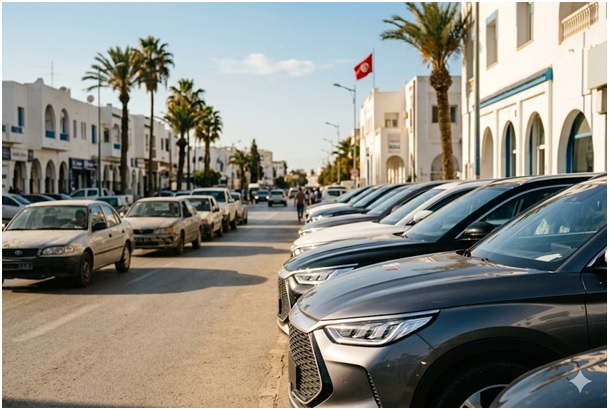
As of the end of May 2026, nearly two out of every three new cars sold in Tunisia are Asian. Within that dominance, a historic shift is underway: Chinese brands are now only 224 units behind Japanese brands. At the current pace, China is expected to become the leading automotive nation in the Tunisian market before the end of the year.
Tunisia’s new vehicle market grew by 12.6% during the first five months of 2026, reaching 27,919 registrations compared to 24,785 a year earlier. Yet this overall growth is not the most significant development.
The real story emerges when registrations are broken down by brand origin, a metric rarely published but reconstructable from registration data. It reveals a market that is now two-thirds Asian and a hierarchy that is rapidly changing.
Asia commands two-thirds of the market, Europe marginalized
When brands are grouped by nationality, Japan remains the leading country of origin with 5,938 units and a 21.3% market share, driven by the exceptional performance of Isuzu, as well as Toyota and Suzuki.
China follows closely with approximately 5,714 units and a 20.5% share. South Korea, represented solely by Kia and Hyundai, accounts for 5,088 units and 18.2% of the market.
India, through Mahindra and Tata, contributes another 919 units. Altogether, Asian brands represent 63.3% of new vehicle registrations.
Europe and the rest of the world share the remaining third of the market, and even some traditionally European brands, such as MG, now operate under Chinese ownership.
The gap between Japan and China has narrowed to just 224 units. However, their trajectories are moving in opposite directions.
Chinese brands have grown by more than 50% year-on-year, increasing their market share from roughly 15% to 20%, while Japan’s position has weakened. Toyota registrations have fallen by 12.6% and Suzuki by 17.6%, with Isuzu alone masking the broader decline. Unless import quotas significantly disrupt the trend, China is expected to overtake Japan before December.
This would make China the leading automotive nation in a Tunisian market historically dominated first by Europe and later by Japan, a quiet but highly significant geoeconomic transformation.
Chery leads an armada of eighteen Chinese brands
China’s rise is no longer driven by just one or two pioneers. Eighteen Chinese brands are now registering vehicles in Tunisia.
Chery has emerged as the clear leader among them, with 1,464 registrations, placing it seventh overall among all brands. It stands well ahead of MG, which recorded 996 units.
Behind these two front-runners, Dongfeng nearly quadrupled its sales to 563 units, BYD increased registrations two-and-a-half-fold to 441 units, and Geely doubled to 328 units. Newcomers such as Omoda, Jaecoo, Jetour, and Lynk & Co have also entered the rankings.
Chery has achieved a symbolic double victory: its Tiggo 1X became the best-selling car in the affordable segment with 741 units, ahead of the Hyundai Grand i10 (738 units) and Kia Picanto (731 units).
The Chinese brand has outperformed Korean competitors in the entry-level market—the segment that determines access to new vehicles for lower-income households.
Kia on top, Renault in freefall
In the brand rankings, South Korea remains dominant. Kia leads the market with 2,556 registrations and a 9.2% market share, narrowly ahead of Hyundai with 2,532 units. Isuzu completes the podium with 2,233 units, thanks to a surge in commercial vehicle sales that more than doubled year-on-year. Citroën follows with 2,010 units, nearly doubling its volume.
The biggest loser is Renault. Market leader at the end of May 2025 with 2,312 units, the French automaker has seen registrations plunge by 31.5% to 1,584 units, dropping to fifth place overall and only seventh place in May alone. Together with Dacia, whose registrations fell by 19.7%, the Artes Group has experienced a sharp decline. Fiat registrations dropped by 42%, while Volkswagen fell by 37%.
The European family sedan, historically the backbone of the Tunisian market, is losing ground under growing pressure from Korean and Chinese competitors.
Growth driven by commercial vehicles, while May declines
The 12.6% market growth masks a significant imbalance. Passenger vehicle registrations increased by only 10.8% to 20,302 units, while light commercial vehicles surged by 17.8% to 7,617 units, representing 27.3% of the market.
Investment by tradespeople and small businesses in work vehicles appears more resilient than household consumption. Isuzu dominates this segment with a 29.3% market share, while Citroën’s commercial vehicle sales jumped 79%.
In contrast, Fiat fell by 38%, and Volkswagen Commercial Vehicles nearly disappeared from the segment, recording just seven units compared with 391 a year earlier.
A warning sign emerged in May, which marked the first monthly decline of the year. Registrations fell by 3.7% to 6,384 units, entirely due to an 8.7% drop in passenger vehicle sales. One month does not establish a trend, but the slowdown comes as authorities prepare to review second-half import quotas.
Grey market reaches 30%, popular cars lose ground
Two additional trends complete the picture.
Registrations of imported used vehicles—the so-called grey market, rose by 20.2% to 12,008 transactions and now account for 30.1% of the total automotive market, which reached 39,927 units.
Mercedes-Benz registrations in this segment increased by 45.6%, confirming that premium vehicles are increasingly purchased through imported used-car channels rather than dealerships.
Meanwhile, the affordable car segment declined by 6% to 3,991 units. The Suzuki Celerio, last year’s leader, saw its sales cut in half. As a result, the market’s growth in 2026 is being driven primarily by commercial vehicles and higher-end segments, rather than by improved access to new cars for lower-income households.
On the distribution side, STAFIM leads the market with 3,633 units and a 13% share, supported by the combined performance of Peugeot, Citroën, and Opel. It is followed by City Cars and Alpha Hyundai Motor, each with around 2,550 units.
Tunisia’s automotive market in 2026 is doing more than simply growing, it is changing hands. It is becoming more commercial, more dependent on the grey market, and, barring regulatory surprises, could soon become the first North African market where China overtakes Japan as the leading automotive nation.