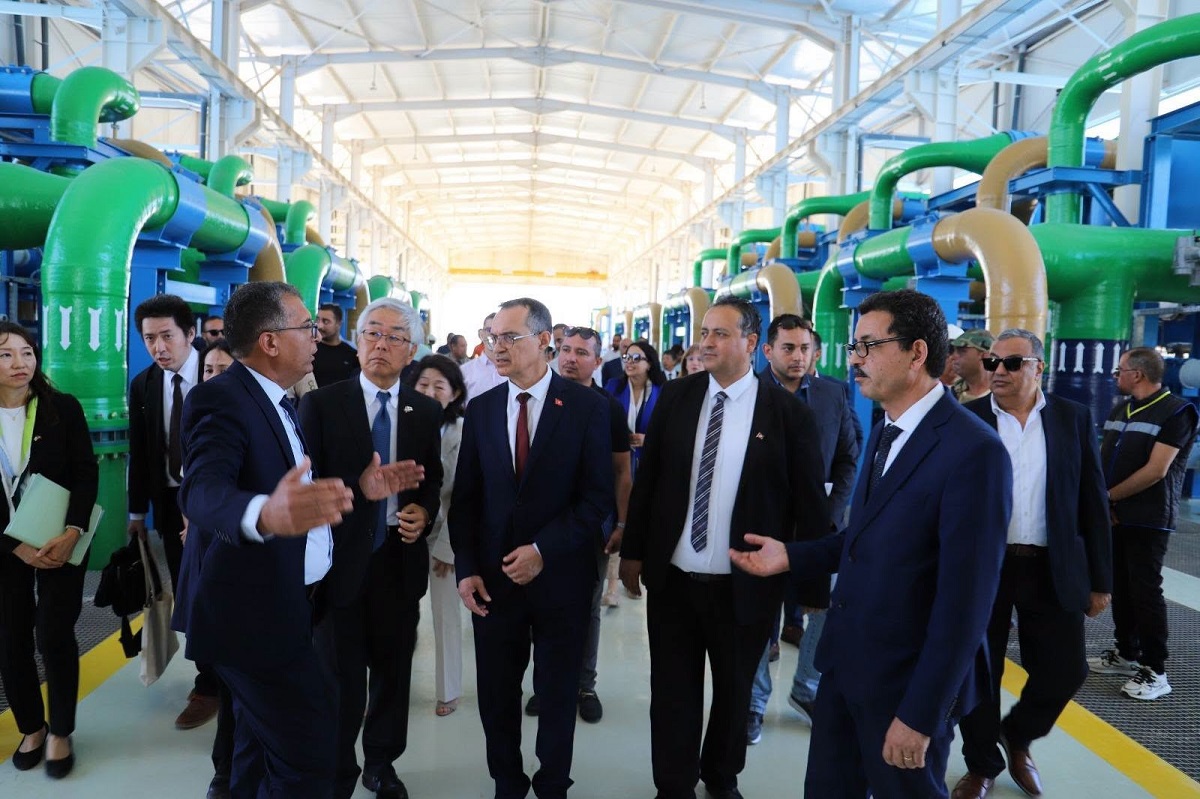
The Ministry of Agriculture, Water Resources, and Fisheries officially brought into service, on June 18, 2026, the Gargour seawater desalination plant in the governorate of Sfax. This is one of the largest hydraulic projects ever carried out in Tunisia.
With an initial capacity of 100,000 m3 per day, the infrastructure has been designed to be expandable, with a capacity that can eventually reach 250,000 m3 per day. A gradual scale-up is already planned, depending on needs and the availability of funding.
The project was carried out with the support of the Japan International Cooperation Agency (JICA), for an updated estimated cost of around 1.18 billion dinars. The technical studies for the expansion have already been finalized.
A first complementary phase of 25,000 cubic meters per day could be initiated as soon as the necessary funding is mobilized, which would gradually increase the site’s production capacity.
Beyond its direct impact on Sfax, the commissioning of the plant will allow a reorganization of the national supply network. Approximately 700 liters per second, previously directed toward Greater Sfax, will be redirected to the governorates of the Sahel and Cap Bon, in order to strengthen their drinking water supply in a context of recurrent water stress.
Sfax, epicenter of water tensions in Tunisia
Tunisia has been accelerating its use of seawater desalination for several years as an alternative solution to secure its drinking water supply. Faced with declining conventional resources, successive years of drought, and increasing pressure on groundwater tables, this choice is now emerging as a central pillar of national water policy.
The Gargour desalination plant is part of this state-led program to bolster water resources, alongside other similar projects in Djerba, Zarat, and Sousse. The objective is to diversify supply sources and reduce dependence on hydraulic transfers from the north of the country.
According to data from SONEDE (the National Water Distribution and Exploitation Company), the project contributes to providing drinking water to approximately 3.7 million inhabitants in the Sahel and Cap Bon, while directly reinforcing the supply to the Sfax region, which is particularly exposed to water tensions.
Greater Sfax indeed combines a high population density and a dense economic fabric, marked by industry, chemicals, agrifood, and textiles, which exerts constant pressure on both drinking water and industrial water demand.
At the same time, the region has limited local resources. Unlike the north of the country, which is better endowed with dams and rainfall; it relies heavily on hydraulic transfers from the SONEDE national network.