The 2025 Annual Report of the Central Bank of Tunisia (BCT) is a document with two layers. On the surface, it presents a respectable 2025: economic growth of 2.5%, inflation brought down to 5.3%, and lower external debt.
Beneath that, however, its 2026 outlook, based on the government’s Economic Budget and commodity price forecasts already overtaken by events, looks less like a forecast than a gamble. The report itself provides the evidence: it adopts a Brent crude oil price projection of $86 per barrel, while the 2026 Finance Law cuts fuel subsidies by nearly 30%.
A Central Bank projecting with someone else’s numbers
The first thing that stands out to a careful reader is that the BCT does not produce an independent growth forecast. The report states plainly that “national economic activity is expected to continue its recovery, with growth estimated at 3.3%, according to the projections of the Ministry of Economy and Planning.”
Sectoral tables are labeled “2026 Economic Budget forecasts at previous year’s prices,” with the Ministry of Economy and Planning cited as the source.
The issuing institution is therefore using the same growth assumption on which the government built its fiscal revenues, including a projected 6.8% increase in tax revenues to TND 47.773 billion.
The issue is not procedural but analytical. If the central bank and the Treasury rely on the same scenario, they also share the same blind spots.
That scenario assumes a favorable sequence of events: phosphate production reaching 5.5 million tons, a “generally satisfactory grain harvest” and a recovery in export-oriented industries, each of which has disappointed at least once over the past decade.
The Governor himself acknowledges that “the national economic and financial outlook remains exposed to several vulnerabilities, notably a possible resurgence in energy prices and higher import costs.”
Oil: Where the reflection begins to crack
It is on energy that the contradiction becomes measurable.
The report notes that during the first quarter of 2026, “Brent crude prices exceeded $100 per barrel in mid-March.” It also cites World Bank projections indicating that “the average Brent price is expected to rise by 24.6% to $86 per barrel, compared with $69 in 2025,” while warning that risks remain “tilted to the upside,” with prices potentially reaching $95 to $115 per barrel in the event of prolonged disruptions.
Yet the 2026 Finance Law, reproduced in the same report, projects a 29.8% reduction in fuel subsidies, from TND 7.112 billion to TND 4.993 billion.
The arithmetic is striking: the government budgets TND 2.1 billion less in fuel subsidies in the same year that the central bank’s adopted outlook anticipates oil prices rising by a quarter.
These two figures appear in the same report, separated by only eighteen pages, without ever being reconciled.
The BCT merely adds a standard caveat, stating that “these fiscal projections remain subject to risks, particularly geopolitical tensions in the Middle East and supply chain disruptions that could increase the cost of hydrocarbon and raw material imports.”
Wheat follows a similar trend, with prices rising 8.9% in the first quarter of 2026, while global production is expected to decline by around 2% in 2026–2027, following three years of relative stability that had eased Tunisia’s cereal import bill.
One unpublished analytical estimate illustrates the sensitivity of the system. The report notes that in 2025, the combined effect of a $12 decline in Brent prices and a 10% drop in extraction activity reduced corporate tax revenues from oil companies by 21.2%, while simultaneously lowering subsidy costs.
A sustained Brent price between $95 and $115 would reverse the largest fiscal flow, the subsidy bill, which appears to have been calibrated for market conditions prevailing before mid-March 2026.
Monetary policy without a target: A reactive stance
Nowhere in the report’s 253 pages does the BCT specify a numerical inflation target.
Instead, the formulation repeatedly used by the Executive Board in May and July 2025 is to “bring inflation back to its long-term average,” a backward-looking benchmark rather than a forward-looking commitment.
Against this backdrop, the BCT cut its key interest rate twice in 2025, by 50 basis points in March and again on December 30, reducing it to 7.0% effective January 7, 2026.
Yet the same report forecasts that “inflation is expected to return to a gradual upward trajectory in 2026, averaging 5.6%, compared with 5.3% in 2025.”
Core inflation is projected to rise from 4.7% to 5.5%, while the positive output gap, around 1.3%, “will continue to reflect inflationary pressures during 2026.”
The central bank therefore eased monetary policy precisely when its own models predicted rising inflation and wage increases in both the public and private sectors.
Based on projected average inflation, the ex-ante real policy rate falls to roughly 1.4 percentage points, and would be even lower if oil-price risks materialize.
Facing imported supply shocks beyond its control, and lacking an explicit inflation target to anchor expectations, the issuing institution condemns itself to reacting rather than steering. It does not lead inflation; it comments on it.
Financing vicious circle: State as banks’ largest customer
The room for monetary maneuver is constrained by a reality the report describes with unusual candor.
“For the third consecutive year, net claims on the Central Government remained the main source of money creation. Their share in the counterparts of M3 continued to increase, reaching 33% at end-2025, compared with an average of 11.2% before the pandemic.”
Meanwhile, credit to the economy grew by only 2.9%, implying a real contraction once adjusted for 5.3% inflation.
The breakdown is even more revealing.
Outstanding loans to public enterprises jumped 15% to TND 16.598 billion, while lending to private businesses increased by just 2.3%. Banks’ holdings of Treasury bills surged 39.4% to TND 25.711 billion.
The 2026 Finance Law projects total financing needs of TND 27.064 billion, with 74.8% expected to come from domestic borrowing and other treasury resources.
The CBT’s dilemma is therefore trapped within a triangle:
Cutting rates further would fuel inflation that it already expects to rise.
Keeping rates unchanged will not prevent the government from absorbing bank liquidity.
Yet the projected 3.3% growth itself requires private-sector credit, the very resource crowded out by government borrowing.
Growth driven, in the report’s own words, by “higher wages and job creation in the public sector” is financed through the very mechanism that restrains private investment.
Foreign exchange reserves: The silent erosion behind the “106 days”
The Governor writes that “net foreign exchange reserves continued to provide comfortable import coverage.”
The numbers tell a more nuanced story.
Reserves fell from TND 27.332 billion, equivalent to 121 days of imports at the end of 2024, to TND 25.115 billion, covering 106 days of imports by the end of 2025, a loss of 15 days in just one year.
The report explains that this decline was amplified by an increase in the daily import coefficient from TND 225 million to TND 237 million.
The underlying mechanism is structural.
External government disbursements amounted to only TND 1.920 billion, while public external debt servicing reached around TND 10 billion, including repayment of the $1 billion 2015 Eurobond in January.
Net external financing has been negative for the third consecutive year: Tunisia is repaying more than it is borrowing.
Tourism receipts and remittances from Tunisians abroad helped fill the gap, notably through TND 4.7 billion in net foreign banknote purchases by the CBT.
For 2026, the Finance Law assumes TND 6.808 billion in external borrowing, up 78% from the TND 3.825 billion mobilized in 2025, even as the report acknowledges that borrowing conditions remain “restrictive.”
This is arguably the most fragile assumption underpinning the entire framework.
If it fails to materialize, the adjustment will occur as it did in 2025, through lower reserves or increased domestic borrowing, reinforcing the very crowding-out mechanism documented by the CBT.
And if Brent remains above $95 per barrel, the energy import bill—which already accounts for “more than half of the overall trade deficit”—would simultaneously squeeze foreign reserves, the subsidy budget, and household purchasing power: the very three variables the official projections assume will remain broadly stable.
A Report that is more lucid in diagnosis than in forecasting
Paradoxically, the 2025 Annual Report is more convincing in its diagnosis than in its forward-looking framework.
All the ingredients for a genuine stress test are there:
Oil above $100 per barrel by mid-March.
Fuel subsidies cut by nearly 30%.
Inflation expected to rise even as interest rates are lowered.
Government claims accounting for one-third of the counterparts of the money supply.
Foreign reserves losing 15 days of import cover in a single year.
What is missing is the analysis that connects these elements.
By adopting the government’s baseline scenario rather than testing its resilience, the CBT falls short of serving as an independent analytical counterweight.
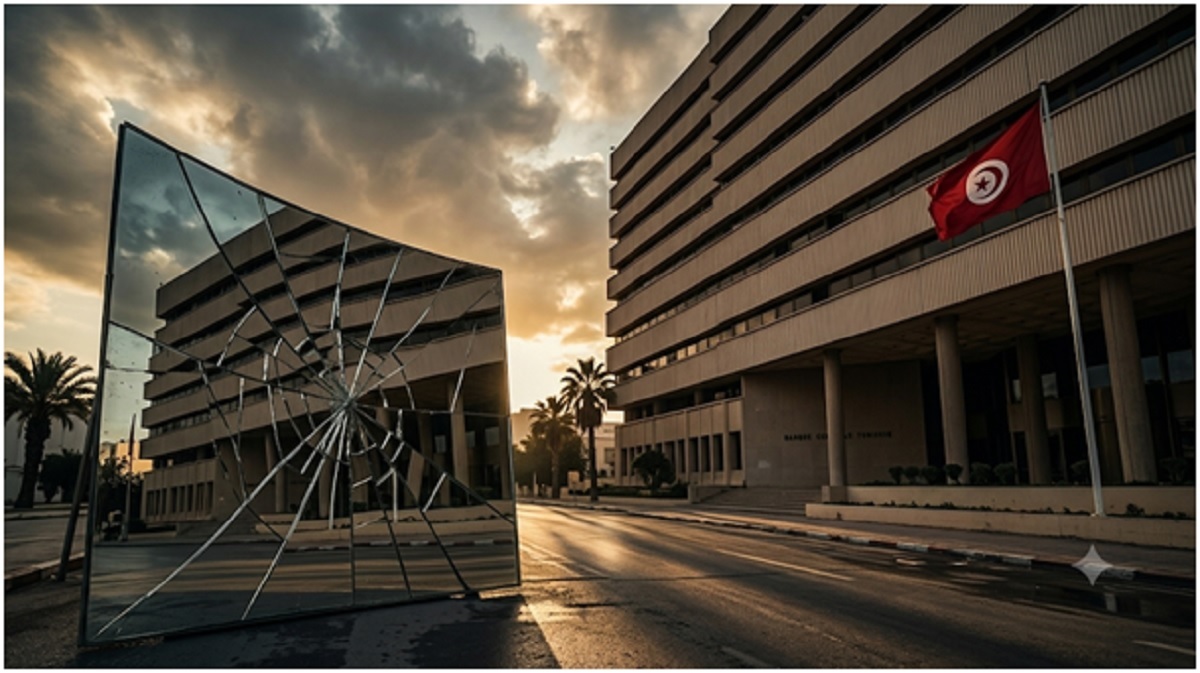
Instead, it becomes a mirror reflecting the state’s vulnerabilities.
A mirror, by definition, never warns of the impact; it merely reflects it.