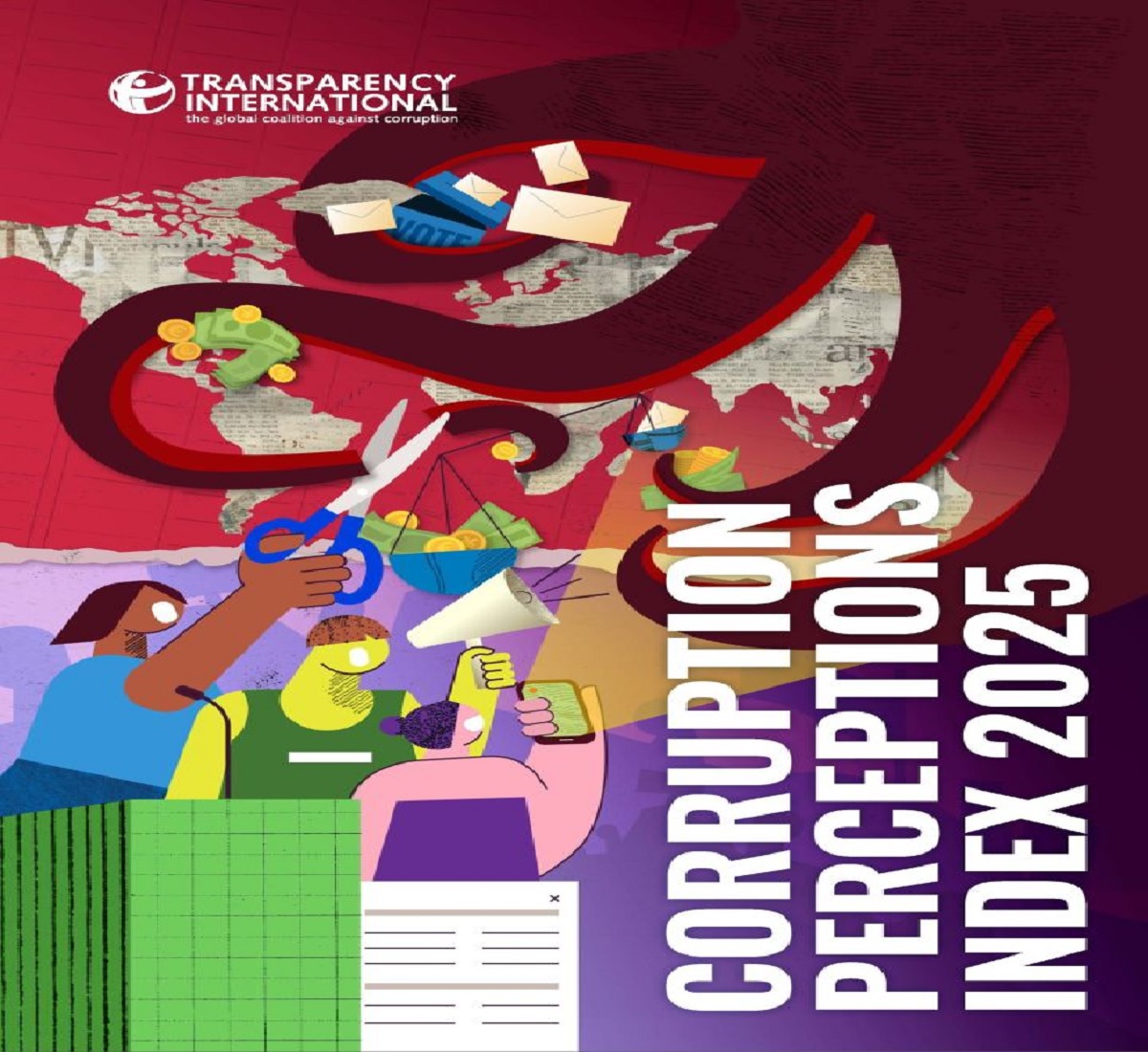
Tunisia ranked 91st out of 182 countries in the 2025 Corruption Perceptions Index (CPI) published by Transparency International, reflecting a continued stagnation in the fight against corruption.
With a score of 39 out of 100, Tunisia has seen no improvement since 2024, remaining well below the global average and far from the group of best-performing countries.
At the African level, Tunisia places 13th, marking a slight improvement compared with the previous edition, when it ranked 15th on the continent.
In North Africa, Tunisia shares the same ranking and score as Morocco, while outperforming several neighboring countries.
Algeria ranks 109th with a score of 34, Egypt and Mauritania are tied at 130th with 30 points, and Libya remains near the bottom of the global ranking at 177th, scoring just 13 points.
Across the rest of Africa, the strongest performers remain the Seychelles, which leads the continent with a score of 68/100 and ranks 24th globally.
Botswana and Rwanda follow, both ranking 41st worldwide with scores of 58, highlighting relatively stronger governance and institutional frameworks.
The Corruption Perceptions Index is published annually by Transparency International and assesses perceived levels of public-sector corruption.
The 2025 edition covers 182 countries and territories and draws on data from 13 external sources, including the World Bank, the World Economic Forum, international think tanks, and private risk and consulting firms. Scores range from 0 (highly corrupt) to 100 (very clean).
Globally, the top of the ranking remains unchanged. Denmark leads with a score of 89/100, followed by Finland (88/100) and Singapore (84/100).
New Zealand and Norway complete the top five, reflecting strong institutions, transparency, and effective public governance.
Among Arab countries, the United Arab Emirates stands out as the best performer, ranking 21st globally with a score of 69/100. Its position is attributed to a structured regulatory environment, efficient public services, and a strong emphasis on administrative transparency.
At the opposite end of the scale, countries plagued by weak institutions, conflict, and limited oversight dominate the bottom of the ranking.
South Sudan ranks last with a score of 9/100, followed closely by Somalia and Venezuela, each scoring 10/100.