While the continent’s economies face inflationary pressures and foreign exchange market volatility, Tunisia stands out for the resilience of its currency.
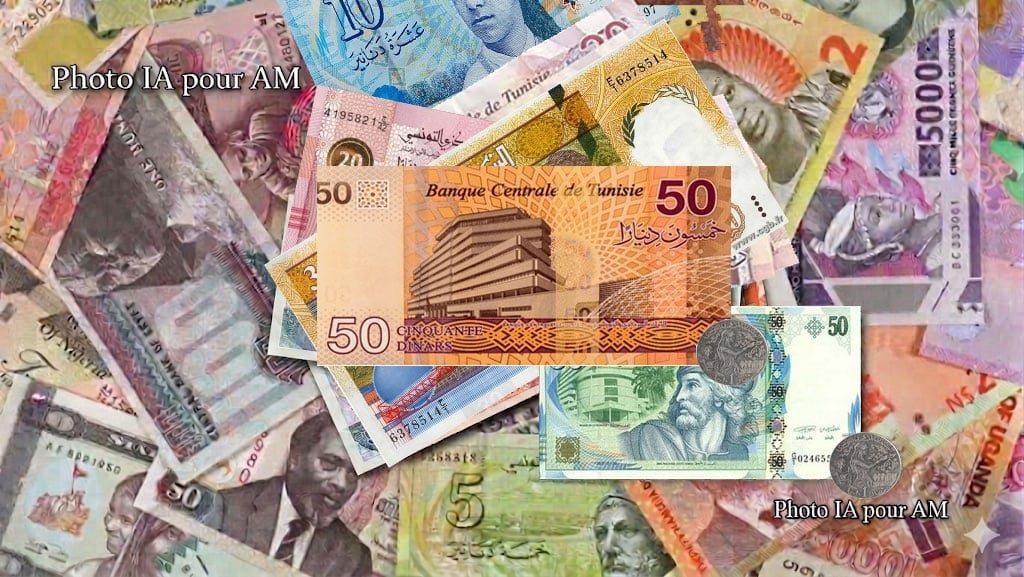
According to a recent analysis published by BusinessDay, the Tunisian Dinar (TND) now holds the top position in the ranking of the strongest currencies in Africa as of March 2026.
Monetary supremacy confirmed
With an exchange rate of 2.93 dinars per 1 US dollar, Tunisia surpasses major economies like Morocco, Egypt, and Nigeria. This performance is not accidental but reflects a specific economic structure:
Strict Monetary Policy: The Dinar’s strength is supported by the Central Bank’s control policies, aimed at stabilizing the currency against external shocks.
Export Support: As recent foreign trade statistics indicate, surpluses generated by key sectors such as textiles and manufactured goods help maintain foreign exchange reserves.
Import Regulation: The strategy of limiting non-essential imports has helped curb the erosion of net foreign assets.
African top 7: Tunisia leads
The ranking established by BusinessDay highlights a monetary hierarchy where North Africa and island nations dominate, with three Maghreb and North African countries in the top three positions, followed by Botswana’s Pula and other regional currencies.
According to a financial source contacted by Africanmanager, who requested anonymity, “This performance of the Tunisian Dinar is the result of a strict monetary policy led by the Central Bank, aimed at stabilizing the currency against external shocks.
The Dinar’s strength is supported by key sectors such as textiles and manufactured goods, which generate significant foreign currency inflows.”
Our source, clearly supportive of the Central Bank of Tunisia (BCT) and Ministry of Finance’s belt-tightening and import regulation strategy, also explains the Dinar’s African leadership as “the strategy of limiting non-essential imports, which has helped curb the erosion of net foreign exchange reserves.”
Challenges and prospects
Although the ranking is flattering, analysts note that a currency’s “strength” must be correlated with internal purchasing power and GDP growth. For Tunisia, the challenge in 2026 remains to transform this monetary stability into a driver of foreign direct investment (FDI) and industrial growth.
Tunisia’s leadership position in this ranking reflects prudent management of macroeconomic balances in a rapidly changing continental environment.
Why Algeria is not included
In the reference document of the Nigerian media (updated April 6, 2026), covering market, business, and public policy news across the continent, the Algerian Dinar (DZD) is unranked.
It does not appear in the “Top 7” strongest African currencies compiled by the Nigerian newspaper for March 2026. Although Algeria holds significant foreign exchange reserves, its official exchange rate against the dollar (about 133–134 DZD per 1 USD in 2026) places it mathematically far behind this leading group.
The main Nigerian economic and financial daily, based in Lagos, often considered the equivalent of the Financial Times or La Tribune for West Africa, uses nominal value relative to the US dollar, which explains the absence of the Algerian Dinar from this limited list. The smaller the number, the “stronger” the currency relative to the dollar.
Why Algeria is not first (or even in the Top 10)
First, because of the “1-to-1 rule.” To rank the strongest currencies, the number of local units needed to obtain 1 US dollar is considered. In Tunisia, only 2.93 TND are needed for 1 dollar. This is a “small” number, so each Dinar has a lot of value. In Algeria, about 133 DZD are required for the same dollar.
Comparing the two currencies, 1 Tunisian Dinar ≈ 45 Algerian Dinars. Therefore, the Tunisian Dinar is, in nominal value, about 45 times stronger than the Algerian Dinar.
This is why Eritrea closes the BusinessDay ranking with a rate of 15.00, because beyond this number, currencies are considered “weaker” in this specific selection.