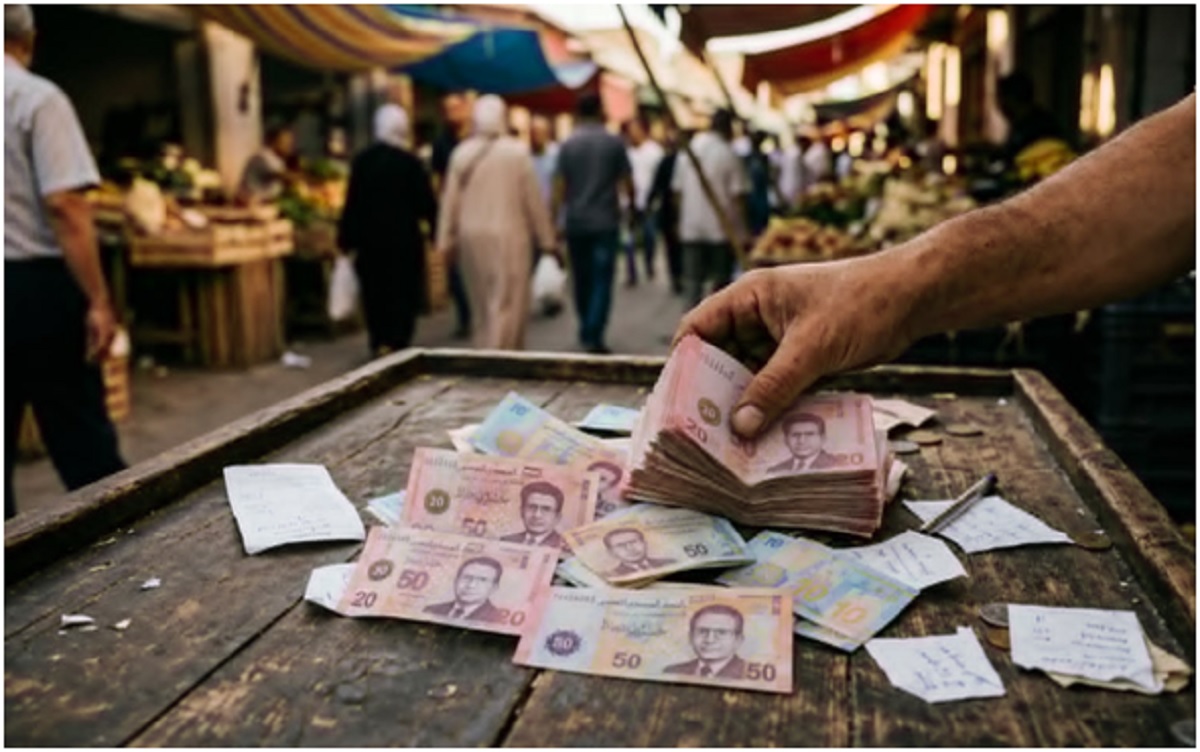
Thirty-nine point zero eight percent. That is the average share of Tunisia’s gross domestic product (GDP) absorbed by the shadow economy over a 35-year period, from 1988 to 2023, according to a study published in March 2026 in the African Development Review, the journal of the African Development Bank. The figure places Tunisia among the most informal economies in the Mediterranean region.
But this diagnosis is no longer merely academic. It is also reflected in real time by a little-discussed monetary indicator: the volume of banknotes in circulation.
29 billion dinars outside banking system
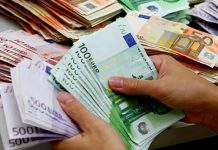
According to data from the Central Bank of Tunisia, the value of banknotes in circulation reached 29.05 billion dinars as of May 22, 2026, up from 23.79 billion dinars a year earlier, an increase of 22.1%.
Relative to GDP, this amount represents 16.4% of national wealth circulating outside the formal financial system, beyond banking traceability, taxation and regulatory oversight.
Officially, the surge in cash usage is attributed to several converging factors: the approach of Eid al-Adha, which boosts household spending; inflation, which mechanically increases transaction values; and the recent implementation of wage increases, which prompted the central bank to inject additional liquidity into the economy. Reports of cash shortages at some ATMs have circulated on social media, highlighting demand that exceeds normal distribution capacity. Further increases are expected during the summer and holiday season.
Behind these temporary factors lies a deeper structural reality: a growing share of economic transactions in Tunisia is deliberately conducted in cash to remain outside the reach of tax and banking authorities.
A structurally informal economy
The AfDB study conducted using the MIMIC (Multiple Indicators Multiple Causes) econometric model, a widely recognized tool for measuring hidden economic activity—concludes that Tunisia is a “structurally informal” economy.
The shadow economy tends to shrink slightly during periods of stability but expands sharply during crises. During the 2020 COVID-19 lockdown, it reached a record 46.62% of GDP. Following the 2011 Revolution, informality remained 6.6 percentage points above its expected trajectory for eight consecutive years.
The London-based research organization World Economics estimates the shadow economy at 31.6% of GDP in 2025, equivalent to roughly $67 billion in purchasing power parity (PPP) terms. Although more conservative, this estimate still places Tunisia in the upper range of the region.
Meanwhile, the United Nations Economic and Social Commission for Western Asia, in its January 2026 report The Hidden Sector, estimated that 72% of the Arab world’s workforce—about 44.9 million people—operates outside regulatory frameworks, social protection systems, and financial inclusion mechanisms. Young people, women, and older workers are disproportionately affected.
Who are Tunisia’s informal workers?
Data from the International Labor Organization and the World Bank, cited by the EU-funded “Nahkiw Iqtisad” project, provide a clear picture.
In 2019, around 1.6 million Tunisians, 44.8% of the workforce, were employed in the informal sector. Three-quarters worked in agriculture, construction, and trade, while 87% earned less than 600 dinars per month.
According to updated figures released by Tunisia’s National Observatory for Employment and Skilled Workers in March 2026, informality now affects 36% of the active population, with notable disparities:
39% among men, compared with 27% among women;
70% among self-employed workers;
52% among people under 30.
The typical profile of an informal worker in Tunisia is a young, low-skilled man, with 83% of those concerned having no formal qualifications.
Formal businesses under pressure
The cost of informality extends far beyond lost tax revenue. It also creates unfair competition for businesses that comply with regulations.
In its first national report on Tunisian enterprises, published in December 2025, the Arab Institute of Business Leaders (IACE) revealed that 63.7% of small and medium-sized enterprises (SMEs) feel strongly affected by competition from the informal economy, compared with 36.9% of large companies.
The gap between economic activity and tax registration is striking. Of more than 824,000 identified economic units, only 170,000 are tax-active and just 103,000 actually file tax returns. Nearly 87.5% are microenterprises with no employees.
As a result, the formal private sector alone contributes 53% of total state tax revenues, increasing pressure on compliant businesses while widening disparities between economic operators.
The automobile market: A barometer of informality
No sector illustrates this reality better than the automotive market.
In the first quarter of 2026, Tunisia’s National Chamber of Car Dealers and Manufacturers recorded 6,869 vehicles sold through parallel-market channels, up 23.1% from the same period in 2025.
These sales accounted for nearly one-third of the 21,334 new vehicle registrations recorded during the quarter.
In other words, one out of every three vehicles entered the market outside official distribution networks, escaping value-added tax (VAT), technical inspection requirements, and manufacturer warranties.
A draft law to change the game
In response to the scale of the phenomenon, the Tunisian government is preparing draft legislation aimed at integrating the parallel economy and combating tax evasion.
The proposed framework would allow informal operators to open bank accounts in dinars or foreign currencies as part of a gradual regularization process. The bill is expected to be submitted in the coming months.
The initiative is promising. However, the AfDB study highlights an uncomfortable reality: every major crisis has expanded the informal sector rather than reduced it.
For the legislation to alter the trajectory, it will need to address the root causes of informality, high tax pressure on formal businesses, the cost of entering the legal economy, weak social protection systems and deep-seated mistrust of institutions.
Otherwise, the 29 billion dinars circulating outside the banking system will continue to grow, and the substantial share of GDP that remains beyond the reach of the formal economy will stay out of sight and out of control.