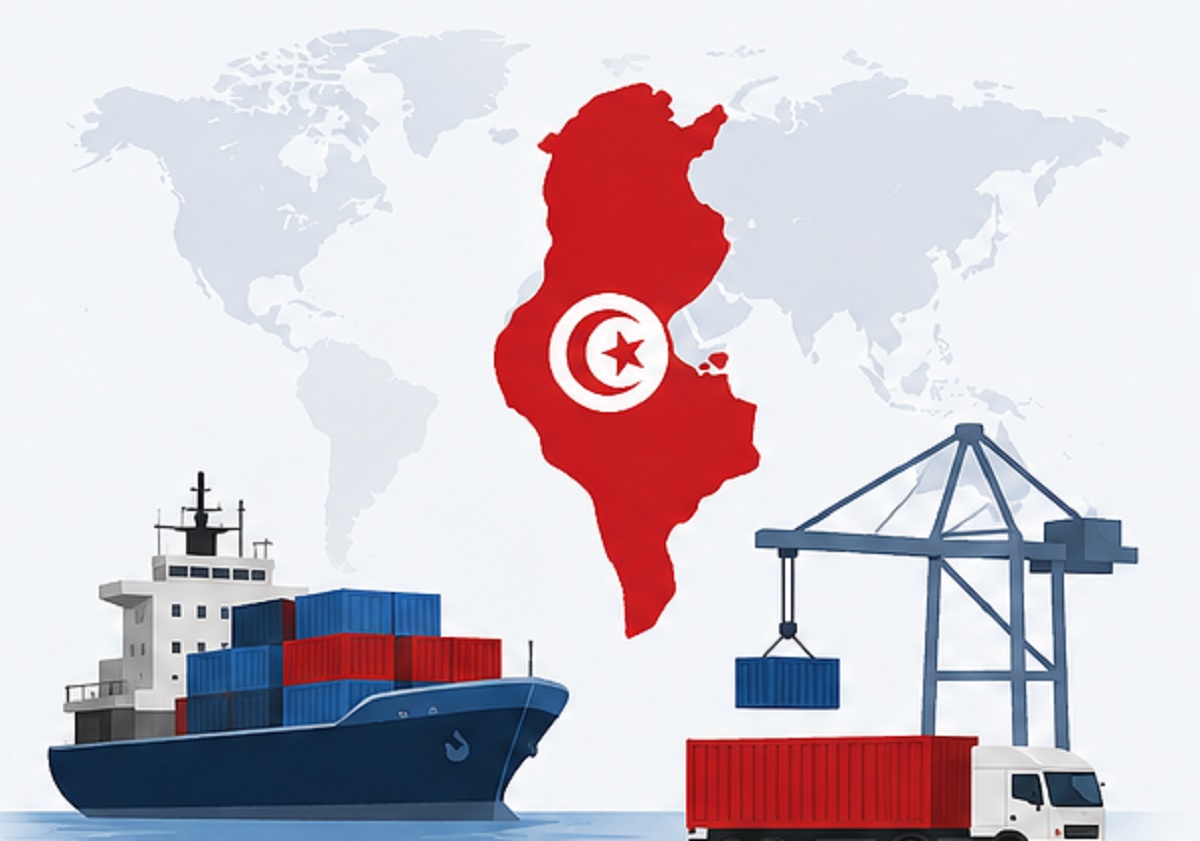
During the first five months of 2026, Tunisia’s trade deficit reached 10.416 billion dinars, compared with 6.410 billion dinars two years earlier.
The usual explanation points to the energy bill. However, figures from the National Institute of Statistics (INS) tell a different story. Tunisia is importing at increasingly higher prices while selling its flagship export products at increasingly lower prices.
Tunisia’s trade balance for the first five months of 2026 stood at -10.416 billion dinars, continuing its deterioration from -6.410 billion dinars during the same period in 2024.
The export-to-import coverage ratio fell from 80.7% to 73% over two years. This is the overall picture that most commentaries will highlight. It is accurate, but it conceals the key issue.
Energy does not explain deterioration
The immediate reaction is to blame the oil bill. The coal, petroleum and petroleum products category does indeed record the country’s largest deficit, at -6.046 billion dinars in 2026.
However, its deterioration over two years remains relatively limited. The energy deficit widened from 5.149 billion dinars to 6.046 billion dinars, an increase of roughly 900 million dinars.
Meanwhile, the non-energy deficit rose from 1.261 billion dinars in 2024 to 4.370 billion dinars in 2026, increasing by a factor of 3.5. The deterioration outside the energy sector, nearly 3.1 billion dinars, accounts for three times more of the worsening trade balance than the energy component.
The issue, therefore, is not oil. It is the erosion of Tunisia’s trade position across virtually all other sectors, from capital goods to processed raw materials.
A deficit driven by prices, not volumes
By comparing values in dinars with quantities in kilograms—data jointly provided by the INS—it is possible to isolate the implicit unit price of each trade flow. The findings are revealing. For most major imported product categories, the increase in the import bill stems not from larger volumes but from higher prices.
Cement and related products provide the clearest example. Their import value increased by 4.4% while import volumes fell by 48%. The price effect therefore reached 52%. Copper prices rose by 36%, inorganic chemicals by 25%, and even energy prices increased by 37% despite lower import volumes.
Tunisia is paying more for quantities that are often smaller. The worsening trade balance is not the result of excessive consumption but rather of external pressures, notably global commodity prices and the external value of the dinar.
Automobiles become country’s second-largest deficit
One exception confirms the rule: the automotive sector. Vehicle imports became Tunisia’s second-largest source of deficit, reaching -1.974 billion dinars in 2026. The import bill surged 52% over two years, rising from 1.964 billion dinars to 2.993 billion dinars.
In this case, volume effects also played a role, with imports increasing from 59,000 tons to 81,000 tons. At the same time, the average price per kilogram rose from 33.3 dinars to 36.9 dinars. Tunisia is importing both more vehicles and more expensive vehicles. This category deserves particular attention as the structure of automotive imports continues to evolve.
Olive Oil: The same problem seen from export side
The export side reveals the reverse of the same issue. Fats and oils, Tunisia’s second-largest trade surplus category with 2.821 billion dinars, conceal a dramatic collapse in prices.
The average export price fell from 21.7 dinars per kilogram in 2024 to 10.2 dinars in 2026, a decline of more than half. To maintain export revenues, Tunisia more than doubled export volumes, from 147,000 tons to 316,000 tons. The country is selling twice as much product for barely the same level of earnings.
Tunisia is exporting raw volume because it is unable to capture the added value associated with packaged and branded products. It should be noted that this category includes olive oil as well as other fats and oils, but the overall trend—more volume for less unit value—remains concerning.
The real diagnosis
Tunisia is caught in a price squeeze effect. On the import side, it is paying increasingly high prices for its supplies regardless of quantity. On the export side, it is selling its flagship agricultural products at steadily declining unit prices. Between the two, the trade deficit widens almost automatically.
The only significant source of resilience remains the machinery and electrical equipment sector, which records the country’s largest surplus at 3.270 billion dinars, driven by the components and electrical wiring industry.
The diagnosis is therefore structural rather than cyclical. As long as Tunisia remains a price-taker on both ends of the equation, importing value and exporting volume, its trade deficit will continue to deteriorate, regardless of fluctuations in oil prices.