As global economic turbulence continues to intensify, particularly amid the war against Iran, maintaining the status quo has become the dominant strategic choice among international policymakers.
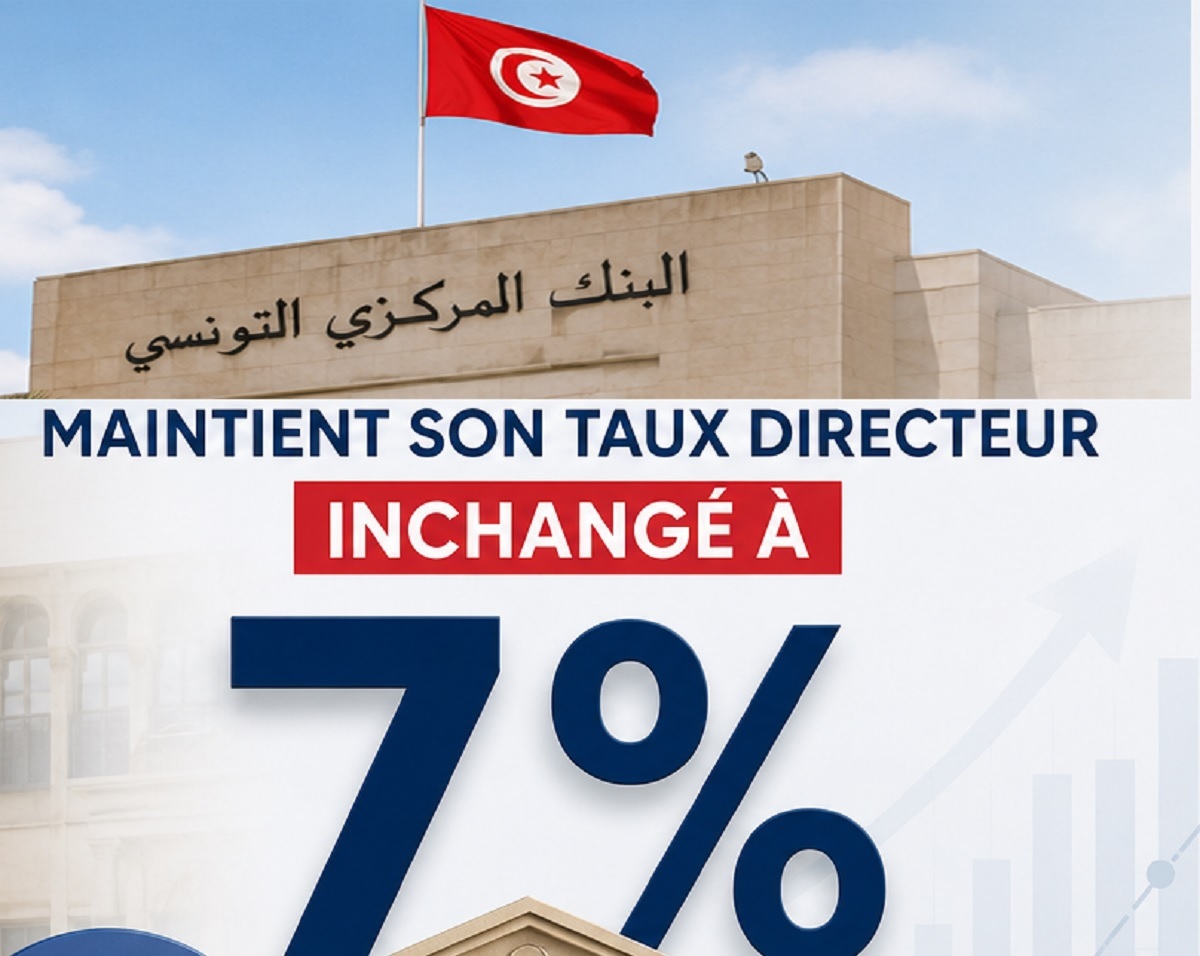
This trend is also evident in the decisions of central banks regarding key interest rates. Tunisia’s central bank, through its Executive Board, decided at its meeting on Wednesday, June 3, 2026, to keep its key interest rate unchanged at 7%.
The decision also reaffirmed the need to continue a prudent monetary policy aimed at preserving price stability, containing inflation expectations and supporting the resilience of macroeconomic balances, according to a statement issued by the Central Bank of Tunisia (BCT).
The meeting reviewed recent economic, monetary, and financial developments at both the international and national levels, as well as inflation trends and the risks surrounding future inflation prospects.
At the national level, economic growth reached 2.6% year-on-year in the first quarter of 2026.
Although slightly lower than the previous quarter’s 2.7%, it remained above the 1.6% recorded during the same period a year earlier, the central bank noted.
The BCT explained that this performance was driven by the recovery of the services sector, the strong performance of agriculture and the resilience of certain industrial sectors, despite a significant contraction in construction activity.
Current account deficit contained at 1.5% of GDP
In the external sector, the strong performance of the services balance and factor income continued to support the current account balance and offset the impact of a widening trade deficit, particularly due to higher energy import costs.
As a result, the current account deficit narrowed to TND 2.731 billion (1.5% of GDP) by the end of April 2026, compared with TND 2.957 billion (1.7% of GDP) a year earlier.
Excluding energy, the current account posted a surplus of TND 1.461 billion at the end of April 2026, compared with TND 726 million one year earlier.
Foreign exchange reserves cover 104 days of imports
Net foreign exchange reserves continued their gradual improvement, reaching TND 25.5 billion, equivalent to 104 days of imports, as of June 2, 2026. This compares with TND 22.6 billion, or 98 days of imports, a year earlier.
Inflation rises to 5.5%
Consumer price inflation accelerated in April 2026, reaching 5.5%, up from 5.0% in March.
This increase was mainly driven by a sharp rise in fresh food prices, whose annual growth rate climbed to 13.3%, compared with 10.9% in March 2026. Core inflation, measured by the consumer price index excluding fresh food products and administered prices, also continued to rise, reaching 5.0%, up from 4.8% the previous month.
By contrast, inflation for administered-price products eased slightly to 1.0% in April 2026, down from 1.2% in March, reflecting the continued freeze on the prices of key subsidized goods.
The Board noted that externally generated inflationary pressures have recently intensified and that their transmission to domestic prices represents an upward risk to future inflation developments.
Global uncertainties remain high
Internationally, the economic environment remains highly uncertain amid persistent geopolitical tensions in the Middle East, whose repercussions continue to affect global commodity and staple food markets.
At the same time, inflation accelerated across major economies in April 2026. The persistence of core inflation also contributed to keeping overall inflation above central bank targets during the first months of the year.
Against this backdrop, major central banks opted to maintain their current monetary policy stance during their latest meetings, citing uncertainty surrounding future price developments.