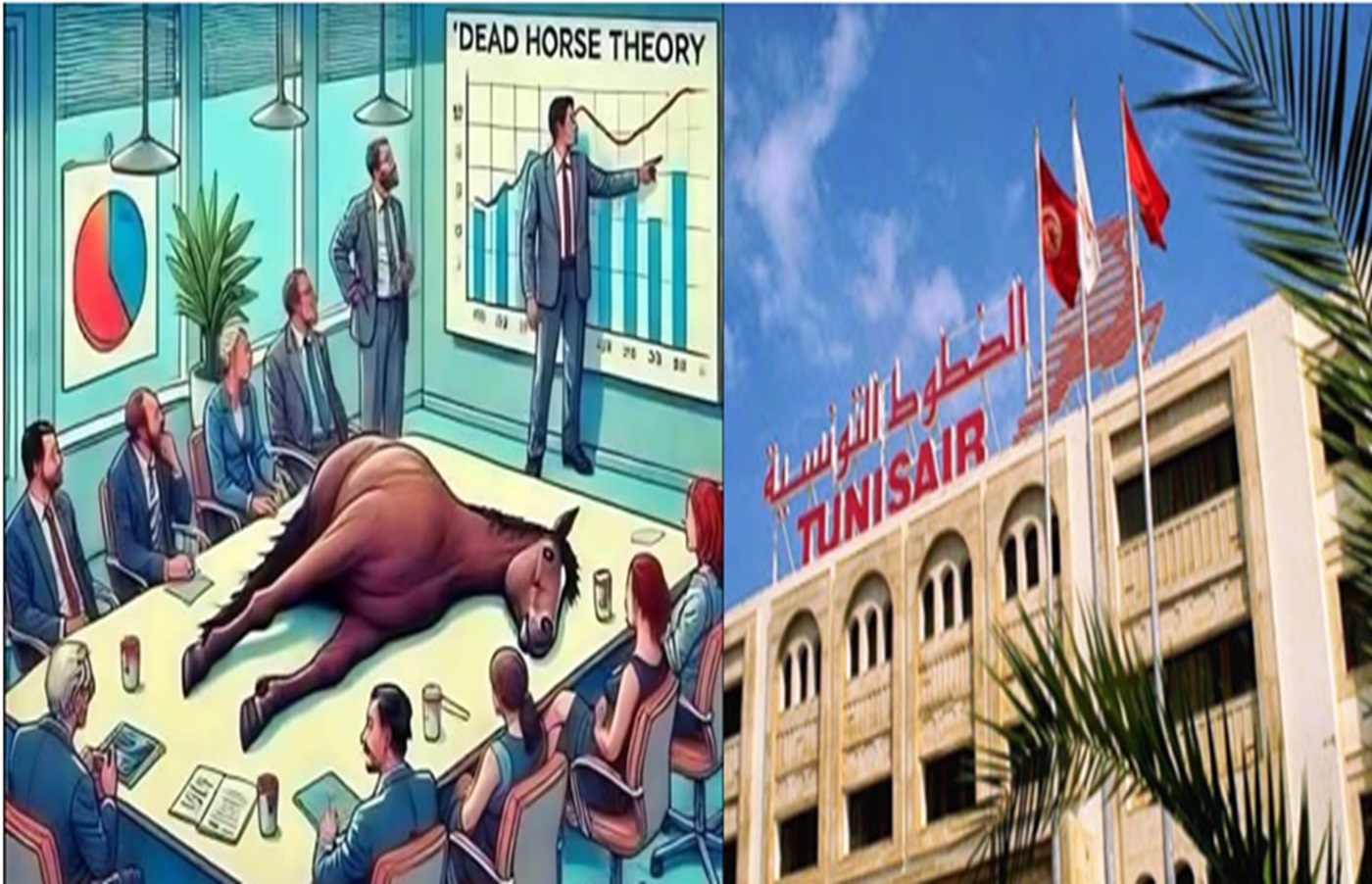
Generally attributed to the Dakota Native Americans, the “dead horse theory” is explained on the universal encyclopedia Wikipedia as “a satirical metaphor reflecting the way some people, institutions, or nations confront obvious problems that are impossible to solve, but instead of accepting reality, they cling to justifying them.
The central idea is clear: if you discover that you are riding a dead horse, the most reasonable thing to do in this specific case would be to dismount and leave it.
– Anything but stop riding a dead horse
However, in practice, the opposite often happens.
Instead of abandoning the dead horse, measures are taken such as:
• Buying a new saddle for the horse.
• Improving the horse’s feed, even though it is dead.
• Changing the rider instead of tackling the real problem.
• Firing the person in charge of the horses and hiring someone new, hoping for a different result.
• Holding meetings to examine how to increase the speed of the dead horse.
• Creating committees or working groups to analyze the dead horse problem from every angle. These committees work for months, produce reports, and finally reach the obvious conclusion: the horse is dead.
• Justifying the efforts by comparing the horse to other similar dead horses, concluding that the problem was a lack of training.
• Proposing training courses for the horse, which implies an increased budget.
• Redefining the concept of “dead” to convince oneself that the horse still has a chance.”
Doesn’t this remind you of something in Tunisia? All public enterprises (PEs), of course. But look closer. A clue? It’s the company ranked 10th among the 20 public enterprises with the largest tax debts to the Tunisian State.
In 2023, those debts amounted to about 11.25 billion dinars for the 42 PEs, including 232.4 million dinars for Tunisair and 217 million dinars for the two state-owned companies producing and selling tobacco!
It all began with Minister Yassine Brahim
As for the financial situation of the national airline in Tunisia, little is known. Five years ago, in 2020, it had a deficit of nearly 232 million dinars, with an operating loss of almost 200 million dinars. Deficits that have almost never stopped increasing.
By the second quarter of 2025, the company, which now owned only 7 aircraft compared to 20 at the end of the second quarter of 2024 and had just a 20% market share, was burdened with debt of nearly 594.4 million dinars.
It is the company that employs (2025 figures published by TSE) 2,721 people, for 19 aircraft of which only 7 are owned. That makes a ratio of more than 143 employees per aircraft, compared to an internationally recognized maximum of 80 employees.
Its worst figure, which regularly haunts even its most faithful customers despite themselves, is a punctuality rate of 39%.
That’s not even counting the recurring labor strikes that shake it, creating a deafening uproar in its narrow corridors where all of Tunisia crowds in like sardines in a can, desperately seeking a planem, amid the complete indifference of the management, minister included.
Tunisair, between lack of money from its owners and search for scapegoats
The ailment eating away at Tunisair began under Yassine Brahim, when this former graduate of École Centrale Paris, the son of a soldier, and former software project manager at Capgemini, became Minister of Transport for seven months on January 27, 2011, right after the so-called revolution.
He then decided to integrate into Tunisair the entire workforce of all its subsidiaries, massively inflating the company’s expenses from which it would never recover.
A heavyweight in all kinds of debts and a featherweight in profits devoured by salaries and expenses, notably a fleet overexploited even for spare parts, the company began a downward spiral.
On the other side, successive transport ministers each came up with their own social and financial restructuring plan, but none managed to convince the various heads of government to inject the necessary cash into Tunisair’s coffers. The last to refuse to rescue Tunisair was former Prime Minister Youssef Chahed.
Since then, the management of the public company Tunisair has focused more on changing CEOs than on finding real solutions to its crisis. And with no cash, there is no lasting solution, only more loans and a frantic search for scapegoats to validate the theory of a public company victim of all possible and imaginable conspiracies.
And this is precisely the resemblance with the “dead horse theory” whose application was detailed earlier in our article!