The company Ciments de Bizerte is going through a difficult financial situation, marked by a significant drop in revenue, cash flow problems, and its inability to meet financial commitments.
Faced with this critical situation, the company has been forced to temporarily suspend its main activity while awaiting restructuring solutions, limiting itself only to grinding imported clinker and unloading petroleum coke for third parties.
No profits, lots of debt, and unpaid taxes!
In fact, although some figures from the first half of the current fiscal year appear positive, sales revenue for the first six months (9.7 million dinars) represents less than one-third of the entire 2024 fiscal year (30.9 million dinars).
Net results remain as negative as in the first half of 2024 (-26.8 million dinars), and debt levels remain high (97 million dinars).
Financial charges reached 5,090,221 dinars at the end of the first half of 2025, compared to 5,926,228 dinars at the same period in 2024, a decrease of 836,008 dinars.
At the start of 2025, the company also recorded a negative gross margin of -2,625,051 dinars for the first half of the year, compared to a negative margin of -1,843,429 dinars for the same period in 2024, a deterioration of 781,622 dinars.
This negative gross margin is mainly due to the halt in clinker production during the first half of 2025, in an attempt to ensure business continuity and maintain its customers and share of the local market.
As if all this were not enough, “an examination of the tax-related accounts led to the recognition of an additional provision for tax risk of 4,446,944 dinars, due to the lack of monthly tax declarations caused by declining revenues and the company’s overwhelming financial situation.”
It is doubtful that the Tax Authority will file a complaint against SCB, as it routinely does against private tax debtors, given that it refrains from doing so with at least 20 other state-owned enterprises.
Business continuity in question!
In fact, “from October 15, 2023, to date, the company has halted clinker production and has no clear information on the resumption of normal activity.
This suspension is due to a shortage of consumable supplies, mainly petroleum coke and refractory bricks, caused by lack of financing.
This event, along with the facts described in Section II of Note II ‘Significant events of the period,’ indicates the existence of uncertainty that may cast doubt on the company’s ability to continue clinker production,” say SCB’s auditors.
The company’s latest press release states that “due to these financial difficulties, the company has been unable to honor its commitments to suppliers and banks.
Medium-term loans increased compared to the same period in 2024, from 120,757,209 dinars to 121,968,913 dinars.
Operating loans fell slightly from 27,110,136 dinars (2024) to 26,771,441 dinars (2025), used for pre-financing inventories. These will be settled at maturity, though renewal for an additional period remains possible.”
Unpaid bills and wasted money
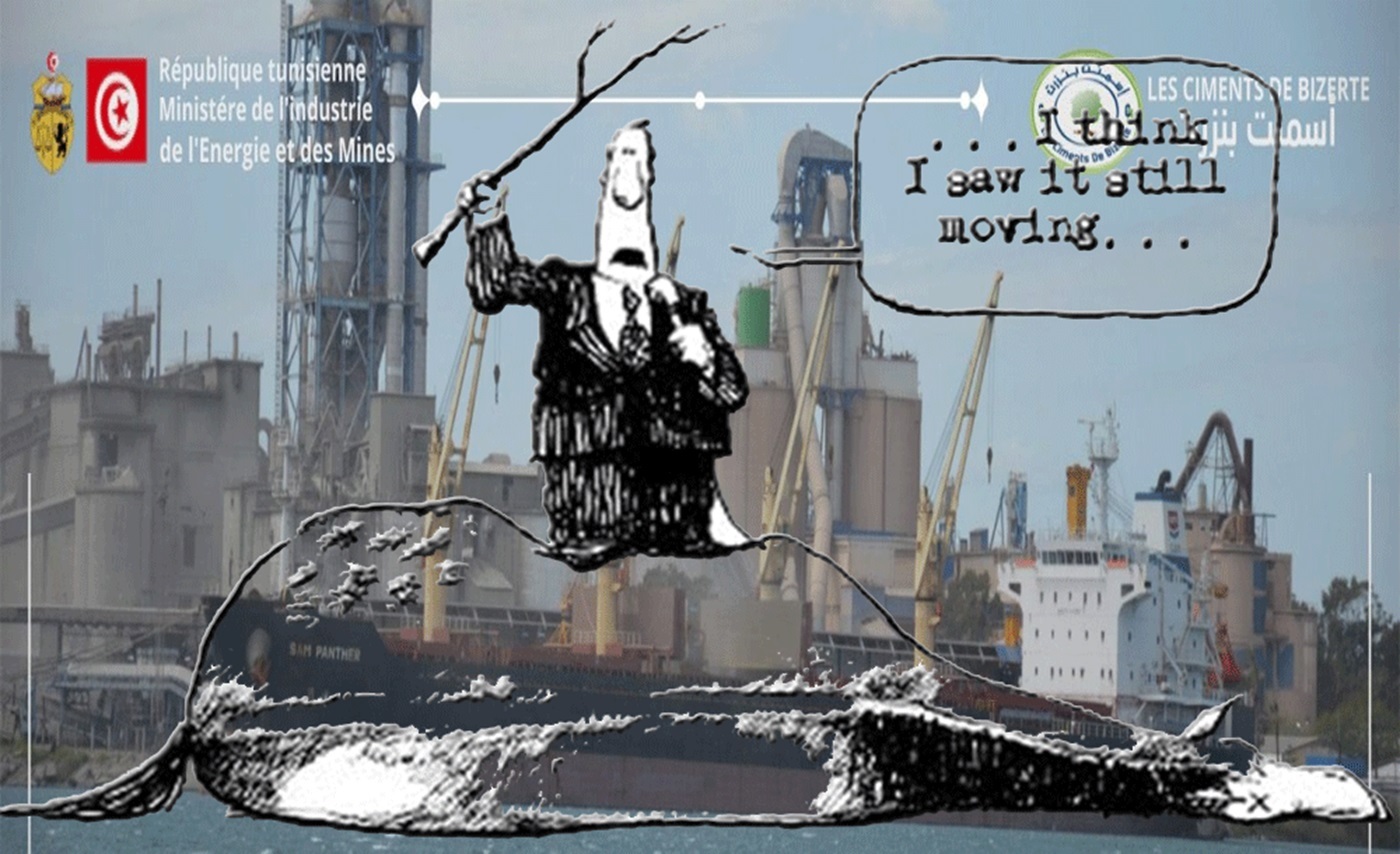
Like a medical board surrounding the carcass of a dead horse, SCB continues to be treated as yet another case of a state-owned enterprise on the brink of collapse, applying the infamous “Dead Horse Theory.”
As with Tunisair, for which a Member of Parliament has called for the resignation of the Minister of Transport, the solution is clear but for now impossible: fresh capital injection by the main shareholder (holding 79.92% of the capital, amounting to 44.047 million dinars according to the TSE).
SCB must then collect its unpaid bills, such as over 2.323 million dinars owed by clients deemed doubtful by auditors, 1.144 million dinars in bounced checks, and more than 3.422 million dinars in unpaid receivables.
However, as with the “Dead Horse,” the Ministry of Industry and SCB’s management prefer the endless carousel of CEOs and to squander money on studies whose results are almost already known.
“At the end of 2024, the company commissioned an external firm to develop a restructuring plan; a report was produced in collaboration with the company’s teams, showing (editor’s note: auditors mistakenly wrote ‘appairer’ instead of ‘apparaître’) the company’s ability to continue operations and meet its commitments, subject to securing the necessary resources and effectively implementing the restructuring plan.”