Africanmanager is primarily an economic and financial site. Advertising is an expense for companies, both those who place ads and those who create them. Advertising investments in news sites have disappeared, as have those in TV channels and creative or display agencies. For all, Ramadan is traditionally a major financial and marketing opportunity.
The holy month of Ramadan 2026 saw a historic 11% drop in ad investments in Tunisia, according to the latest data from “medmedia-group.” This trend affects all media except television, which remains essential. Here are the main trends and key players during this crucial period for Tunisian media.
Television remains dominant
Ramadan 2026 confirms a long-term trend: television continues to dominate during the holy month, but audiences are increasingly concentrated on a smaller number of channels. The fragmentation of Tunisia’s audiovisual landscape does not benefit everyone, widening the gap between leaders and the rest.
Nessma El Jadida leads, followed by El Hiwar Ettounsi
Nessma El Jadida emerged as the big winner of this Ramadan, with a record penetration rate of 42.54%, confirming its place as the undisputed leader of Tunisian TV. Behind it, El Hiwar Ettounsi performed solidly with 29.87%, driven by series that captured and retained a large audience. Watania 1 rounded out the podium with 12.4%, thanks to local productions that kept viewers engaged throughout the month.
Together, these three channels captured more than 84% of total viewership, leaving the rest to share the scraps of an increasingly concentrated market.
Series drive audience engagement
Channel performance is largely thanks to their series. Drama remains the king of Ramadan programming in Tunisia, and the numbers clearly confirm it.
On Nessma El Jadida, “Sahbek Rajel” achieved the highest penetration of Ramadan at 38.63%, followed by “Accident” at 27.19%. These two productions alone explain much of the channel’s lead.
On El Hiwar Ettounsi, “El Khottifa” and “Hedhi Ekhritha” scored similarly at 29.87% and 29.07%, reflecting consistent programming and successful audience retention.
Watania 1 relied on “Hayet” and “El Matbaa” for its schedule. With 12.4% penetration, the public channel remains behind the two private giants but maintains a significant presence thanks to national productions.
Other channels struggle
Other channels find it hard to compete. Hannibal TV reached 4.97%, Telvza TV 2.63%, and Al Janoubia TV 1.49%. Without a flagship series capable of creating buzz, it is difficult to attract viewers who now have many options and quickly switch between them.
Diversifying programs is no longer enough. What matters during Ramadan is the ability to produce or acquire strong drama content that sparks word-of-mouth and becomes a topic of conversation—at the table, on social media, or at work the next day.
Digital pressure in the background
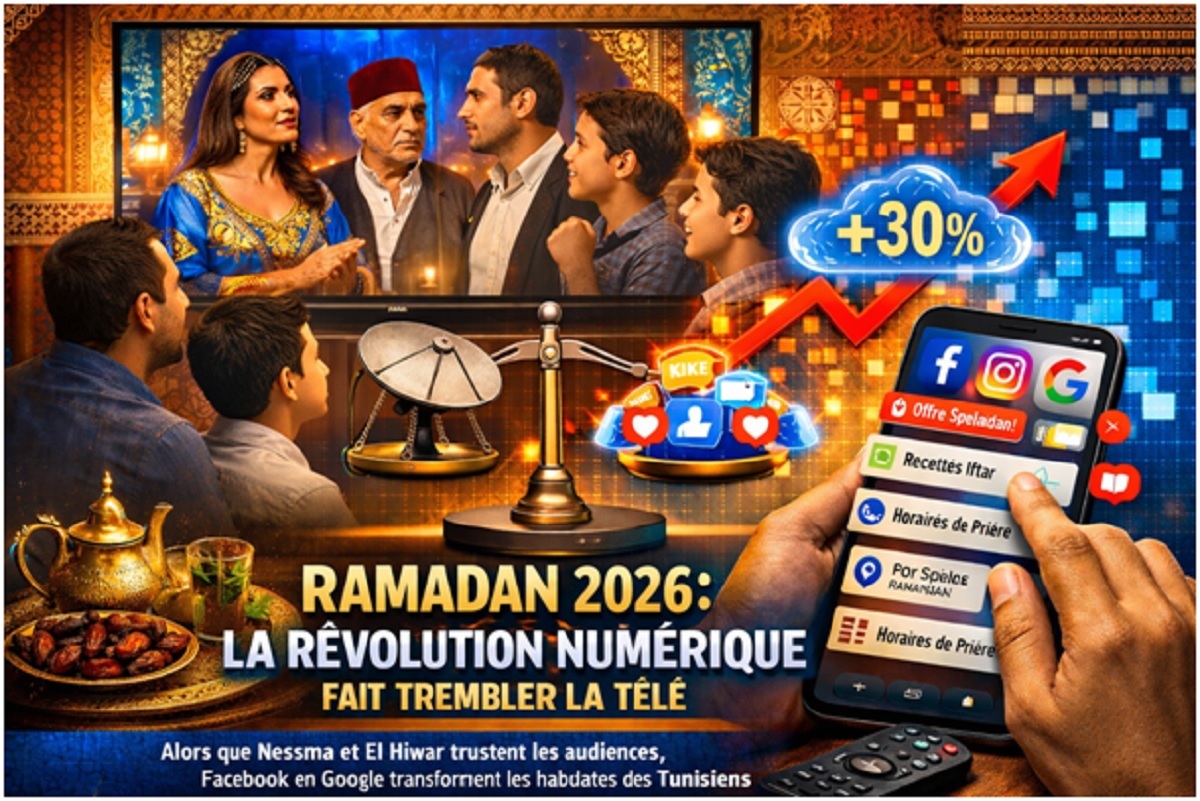
These results reflect a deep transformation in media consumption habits. Television remains dominant during Ramadan, but digital platforms, streaming, social media, and on-demand viewing, are steadily taking viewers’ attention, especially among younger generations.
The power of Ramadan lies in its resistance to this fragmentation, the collective gathering in front of the TV remains a strong social and cultural reality in Tunisia. But channels unable to offer content that creates this collective event risk gradual audience erosion, even during the most-watched month of the year.
Concentration raises questions
The dominance of Nessma and El Hiwar Ettounsi raises broader concerns about the balance of Tunisia’s TV landscape. When two private channels alone capture over 72% of the audience during Ramadan, the entire sector’s economy is affected, advertising budgets follow viewership, further widening the gap between dominant players and struggling channels.
For small and mid-sized channels, the challenge is no longer just editorial, it is financial. Without sufficient resources to invest in quality productions, breaking the cycle of low audience and low ad revenue is difficult.
Ramadan 2026 thus depicts a two-speed Tunisian TV landscape, where concentration is increasing, series make and break channel fortunes, and television, despite digital pressure, remains the main arena in an increasingly competitive market dominated by a few players.