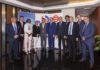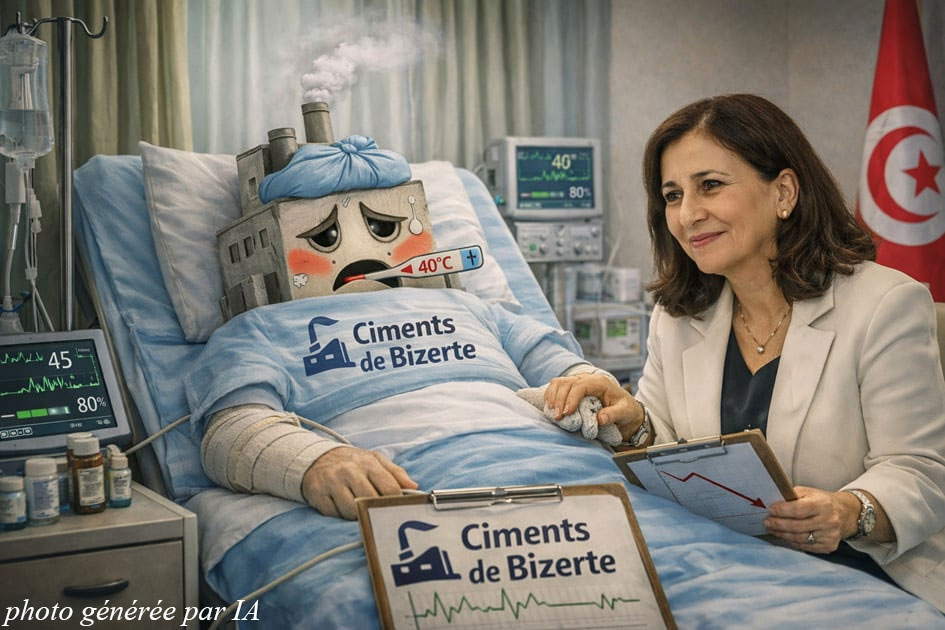
A small Cabinet meeting held on Tuesday, March 17, at the Government Palace in Kasbah, under the chairmanship of Prime Minister Sara Zaafrani Zenzri, was devoted to examining the restructuring of Ciments de Bizerte.
According to a statement from the Prime Ministry, the meeting discussed ways to revive investment in this public company, considered one of the country’s major historic enterprises that contributed to the development of Tunisia’s cement sector, a strategic and vital industry.
A two-phase rescue plan, without clear details
The Prime Minister stressed the need to support the company and launch its restructuring to save it from its current difficulties.
She noted that a detailed presentation was made on the company’s technical and financial situation, human resources, commercial activity, restructuring program, key planned reforms and an investment plan structured in three phases.
However, the statement provided almost no financial details and did not clarify whether the restructuring would be purely financial or also social. As a listed company, it would have been expected for management to engage shareholders and inform them of the restructuring details.
The only clear takeaway is that restructuring will occur in two phases (without a timeline):
Phase 1: Restart production by reactivating the clinker production line, while controlling costs and reducing reliance on external services.
Phase 2: Increase production capacity through equipment modernization and improved operational mechanisms.
A third phase is also mentioned, focusing on energy efficiency, environmental compliance, competitiveness, and the implementation of an integrated information system.
However, all these steps require significant funding, raising the question of where the money will come from, especially as the company is already financially strained and urged to limit borrowing. No answers were provided regarding potential capital increases or state funding.
Short-term “emergency measures”
In the short term, authorities recommended continuing the acquisition and processing of clinker while controlling production costs to maintain competitive pricing. However, without immediate cash injections, such measures may remain insufficient.
The Cabinet also issued broad recommendations, such as developing and promoting certain activities, without concrete details. These include rehabilitating rail transport (currently slow and inefficient), promoting bulk cement use (questioned for practicality), creating a sales subsidiary in the capital, and expanding sales in the northwest and Greater Bizerte region.
Long-term ambitions
In the longer term, the meeting proposed developing the company’s port activity (it already has its own quay), diversifying products, and targeting promising markets. It also called for supporting the company while preserving its financial balance, without specifying whether the state, as the main shareholder, would lead this effort.
A fragile financial situation
According to the company’s 2025 interim financial statements, its situation remains fragile. Turnover dropped to around 18.6 million dinars, reflecting ongoing production difficulties and weak market demand.
While costs have somewhat improved, activity remains low, indicating underutilized industrial capacity rather than true optimization. Financial charges exceed 5 million dinars, heavily impacting profitability, while liquidity remains under pressure due to significant bank debt.
Overall, the company is still in a critical phase marked by low production, weak profitability and the urgent need for deep restructuring to ensure medium-term viability.
A struggling listed company
Tunisia’s cement sector includes nine producers with a total capacity of nearly 12 million tons and over 4,000 jobs, making it a key contributor to economic growth and exports.
Founded in 1950 as “Ciments Portland de Bizerte,” the company began production in 1953 and was nationalized in 1959. The state currently holds about 79.81% of its capital, with 20.19% publicly traded on the Tunis Stock Exchange since 2009.
Once listed at 11.5 dinars, its share price has fallen below 1 dinar (around 0.48 dinars), with a market capitalization of about 21 million dinars, highlighting the depth of its financial troubles.