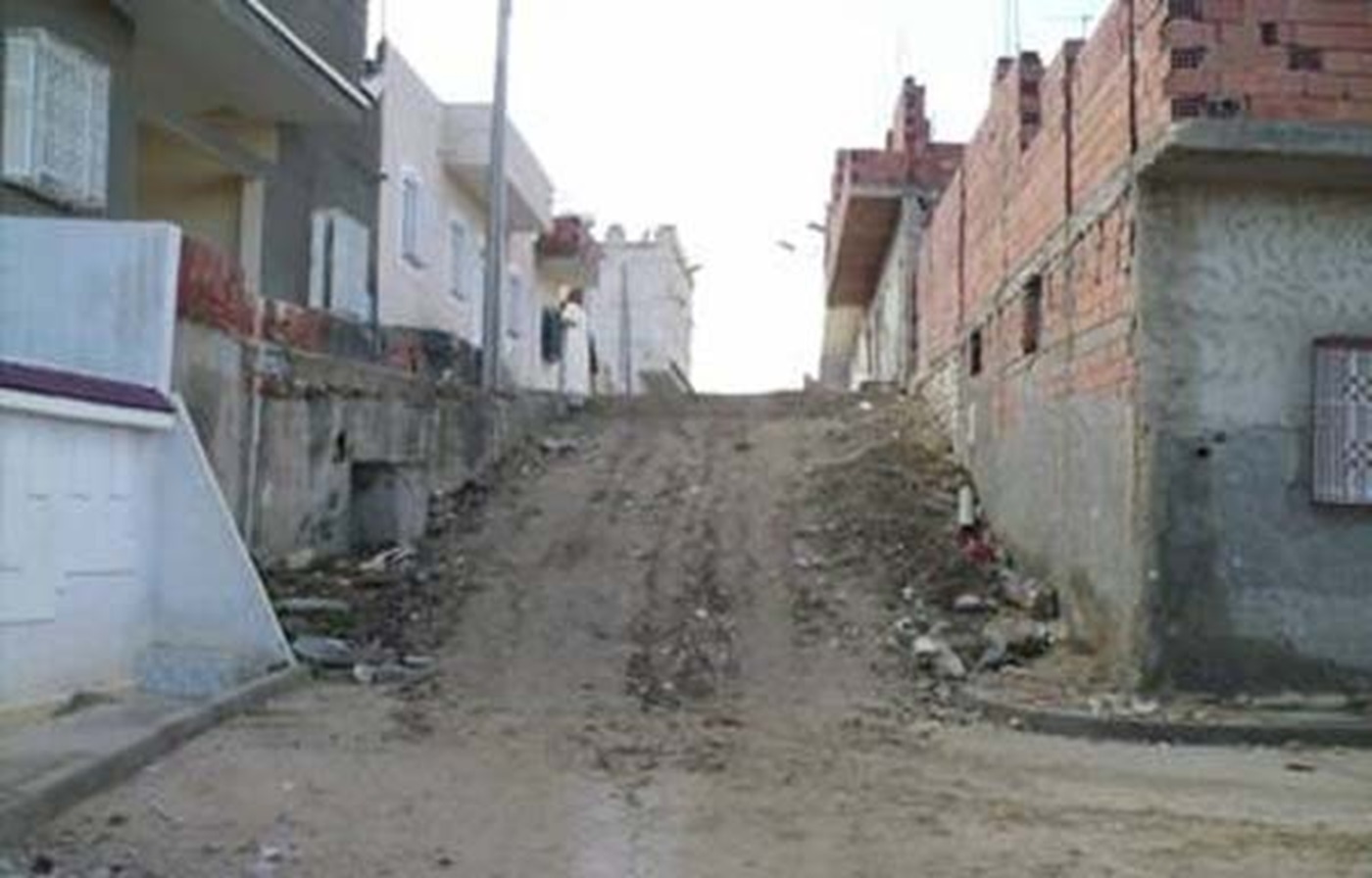
Official statistics show that 38% of annual constructions in Tunisia are built outside regulated zones and without legal permits.
On average, about 80,000 new housing units are built each year, 29,000 of which are located in informal areas.
Illegal or “anarchic” construction has long plagued municipalities, becoming a growing scourge they have tried to combat for decades, only to see the issue worsen, especially since the 2011 Revolution.
This phenomenon dates back to the post-independence era and remains unresolved. It affects not only the aesthetic appearance of cities, but also the implementation of urban master plans.
The spread of informal housing is largely due to the imbalance between population growth and economic development, rising demographic pressure and worsening socio-economic conditions, further fueled by rural-to-urban migration in search of jobs.
The mismatch between demographic policies and the needs of various social groups has also played a role. Another major factor is the conversion of agricultural land, about 400 hectares per year, to accommodate public infrastructure and economic projects, encouraging the growth of informal housing around these developments.
Draft law to legalize informal neighborhoods
In response, Tunisia’s Parliament (ARP) has referred a draft law to the Committee on Strategic Planning, Sustainable Development, Transport, Infrastructure, and Spatial Planning, aimed at legalizing informal neighborhoods.
The initiative could affect up to one million Tunisians living in these areas.
Proposed by a group of MPs, the bill includes 12 articles outlining eligible cases, property registration costs, and procedures for regularization.
Article 1 aims to legalize and grant property rights for homes built without permits or in violation of planning rules before **December 31, 2025.
The goal is to provide 800,000 to 1 million Tunisians, across 1,400+ informal neighborhoods, with property titles and access to loans.
Article 2 applies to homes built on private land without legal procedures or municipal urban planning regulations.
Article 3 states that any Tunisian citizen can qualify if they can prove land ownership, comply with local planning standards, and do not violate others’ rights or environmental regulations.
Articles 4–5 detail the application and review process and Article 6 sets land registration fees based on area size.
Articles 7–11 explain how to obtain the legalization certificate and associated benefits.
Finally, Article 12 states that future violations will be punished by demolition or a fine three times the land’s value.
This bill seeks to balance urban planning with social inclusion, turning informal neighborhoods into legally recognized and economically integrated communities.