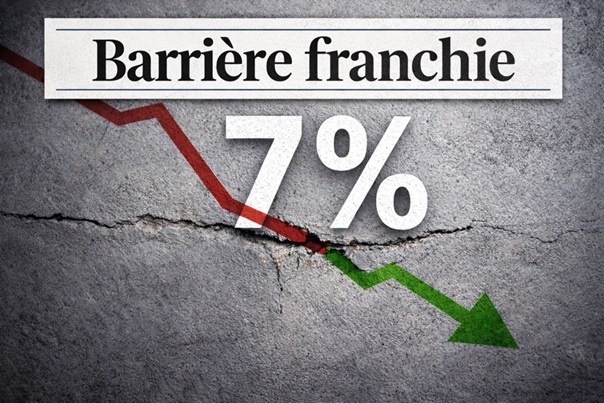
The Money Market Average Rate (MMR) crossed a symbolic threshold, settling at 6.99% in February 2026. This decline, unseen since 2022, promises to ease the debt burden on households and restore some room for maneuver for businesses, in a context of declining inflation (not to say disinflation, since the Central Bank of Tunisia, which remains responsible for controlling inflation, has never set an explicit inflation target), as confirmed by the data.
However, while the drop in the MMR is a necessary step, a lasting recovery in investment will also depend on the removal of structural barriers and the stability of the regulatory framework throughout the rest of 2026.
A historic low over past four years
This is indeed a historic floor over the last four years. After peaking at 8.05% in March 2023, the MMR has continued its downward trend. This is the first time the indicator has fallen below the 7% mark since October 2022. The move follows the Central Bank of Tunisia’s decision to cut its key interest rate to 7% at the end of December 2025, driven by a decline in inflation to 5.4% for 2025.
Inflation further eased to 4.8% in January 2026, after stabilizing at 4.9% during the last quarter of 2025.
Toward lighter household credit and a revival of real estate?
For households, this decline is crucial. It should automatically translate into lower monthly payments for variable-rate loans (consumer credit and housing loans).
In this regard, the central bank and commercial banks will need to communicate clearly to explain how this reduction will be applied in practice and to avoid confusion among citizens.
The real estate sector, which is particularly sensitive to fluctuations in the MMR, is awaiting a strong signal. In 2025, housing loans recorded a historic decline (the first since 2011), as households favored small renovation loans in the face of eroding borrowing capacity.
Falling below the 7% threshold could therefore reignite the “homeownership dream” and make access to property easier.
Easing financial pressure on businesses
The productive sector, whose outstanding credit exceeds 90 billion dinars, is finally seeing its operating costs decline. This is an encouraging signal: with lower financial charges, private companies—whose financing remained sluggish in 2024—will be able to clean up their balance sheets, often weighed down by financial expenses that consume a significant share of their cash flow.
By extension, private investment could benefit from a much-needed breath of fresh air. A more attractive cost of money is essential to counter the “crowding-out effect” observed in recent years, where financing for public enterprises often took precedence over that of the private sector.
This new environment raises hopes for a better balance in credit allocation. Data show that banks remained selective at the end of 2025, with the gap between deposit growth and credit growth reflecting continued caution.
Removing structural barriers: A prerequisite for investment
While the decline in the MMR reduces the cost of capital, it is not sufficient on its own to revive private investment in a sustainable way. Recovery will depend on lifting major structural barriers.
These include stabilizing the regulatory framework and facilitating access to financing for SMEs, whose bank credit has remained stagnant. The effectiveness of certain monetary policy instruments is also tied to the economy’s ability to channel funds into productive projects rather than consumption.
Moreover, developing guarantee mechanisms remains essential to reduce corporate risk profiles and encourage banks to ease their selectivity.
A vast undertaking, especially as Tunisia once again turns its back on the International Monetary Fund (IMF), preferring to pursue structural reforms on its own.
Yet a closer look at the current outcomes of the check reform and, more recently, the generalization of electronic invoicing, argues in favor of strengthening technical cooperation with international institutions, at least to benefit from operational support and knowledge transfer.