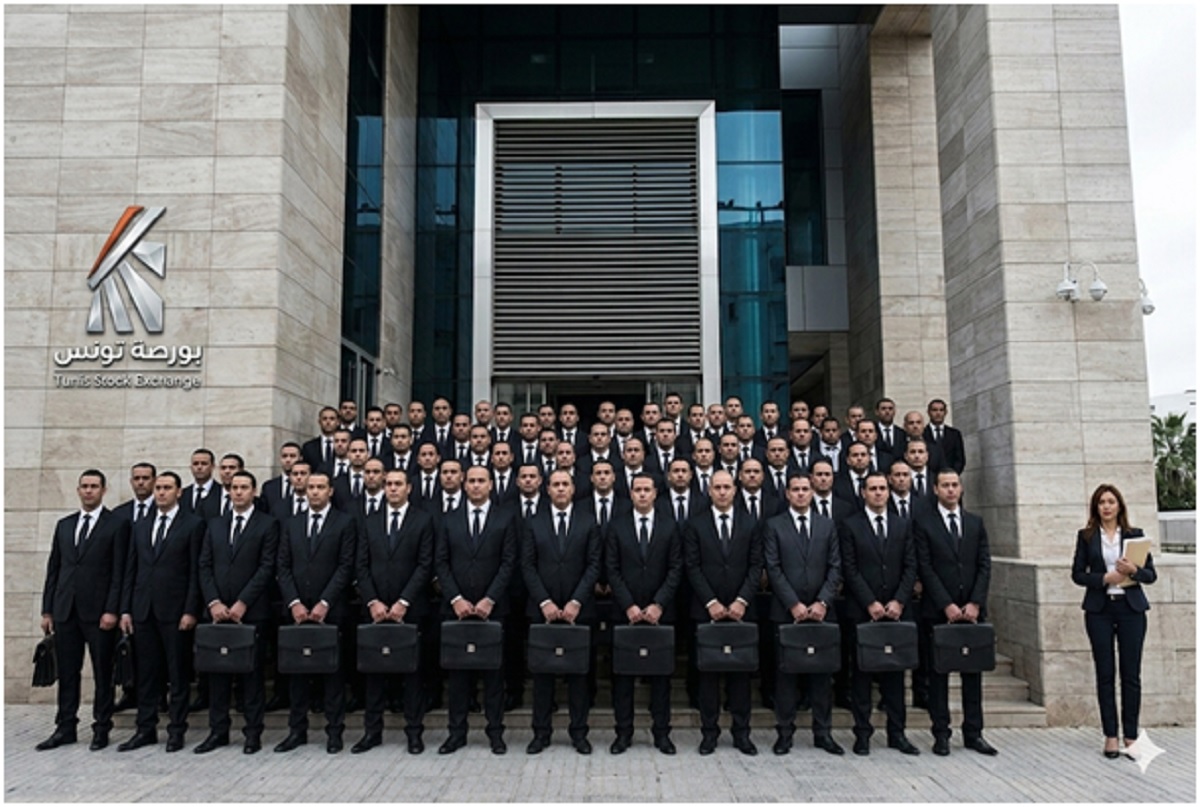
The Tunis Stock Exchange has just published its annual report on the governance of listed companies for the 2025 financial year. The document is polished and well-structured, offering a broadly positive picture of a financial market that is making progress.
The numbers are there: 19.5% of board members are women, up from 17.7% in 2024. More independent directors. Better representation of minority shareholders. Everything, it would seem, is moving in the right direction. Except that real governance is not just that.
A market that remains a men’s club
Let’s start with what the headline clearly shows. In 2025, out of 714 directors sitting on the boards of the 75 companies listed on the Tunis Stock Exchange, 575 are men. Four out of five.
The 19.5% female representation is presented as a significant improvement and it is, since it was 13.5% in 2020. But it remains structurally low, and above all, it is progressing without any legal constraint.
Tunisia has no gender parity quota, unlike France and several European countries. The result is predictable: some sectors remain largely unaffected by change.
Telecommunications show only 6% female representation. Companies such as ARTES, MONOPRIX, SOTUMAG, UADH, SMART TUNISIA, and TAWASOL GROUP HOLDING have no women on their boards in 2025. Without legal obligations, diversity remains optional.
Independence still in limbo
On the issue of board independence, the report notes an increase from 115 to 121 independent directors between 2024 and 2025. But it glosses over an uncomfortable fact: 20% of listed companies are still not compliant with the law.
Law 2019-47, which aims to improve the business climate, requires every listed company to have at least two independent directors on its board. Six years after its entry into force, 15 out of 75 companies still fail to comply. This non-compliance rate is exactly the same as in 2024. It has not moved at all.
Companies such as SOTUMAG, UADH, TUNISAIR, SIPHAT, CIMENTS DE BIZERTE, SITS, ALKIMIA, and SOTRAPIL are among those resisting compliance, without any apparent sanctions. The Tunis Stock Exchange and the Financial Market Council (CMF), the regulator, observe and the report documents without questioning.
Financial transparency: the missing pillar
This is where the report shows its deepest limitations. Corporate governance in listed companies starts with accountability, not just appointing “independent” directors on paper.
It means publishing financial statements on time, disclosing executive compensation, and ensuring shareholders have access to complete and reliable information.
On this front, the report is strikingly silent.
Several listed companies, or companies making public offerings, have gradually stopped publishing full financial statements. Tunisair, a listed company, is the most emblematic example of this drift.
Other issuers now limit themselves to interim statements or basic activity indicators, without full, certified accounts being properly accessible to the public. The Tunisian-Libyan Bank (BTL), a publicly offering institution, illustrates this regression. Eurocycles, a listed company, is another example.
In addition, several issuers skillfully bypass the obligation to disclose detailed information on executive pay and benefits, information that is essential for assessing potential conflicts of interest and the true quality of governance. These omissions are not accidents. They reflect a gradual shrinking of transparency, in the silence of the regulators concerned.
When the regulator stays silent
The central question is simple: what is the purpose of the Tunis Stock Exchange and the CMF if listed companies can, year after year, fail to publish accounts, fail to appoint independent directors, and fail to designate minority shareholder representatives, without consequences?
A governance report that documents non-compliance without examining supervisory failures leaves out a crucial part of the picture.
Good governance is not a checklist. It is a system in which information flows freely, rules apply equally and regulators have both the means and the will to enforce the law. In Tunisia, this system is still under construction. The 2025 report, unintentionally, is its clearest proof.