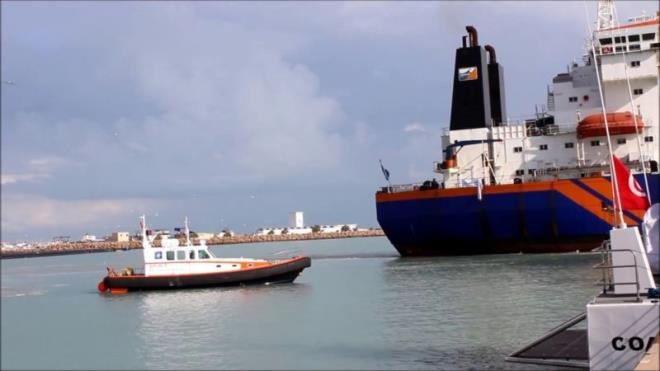
The Zarzis Commercial Port has launched its first-ever container transport activity, marking a historic milestone with the arrival of its inaugural container vessel on Sunday, April 26, 2026.
The new shipping line now connects the port of Zarzis to Rades Port in the southern suburbs of Tunis, as well as to the ports of Gioia Tauro in Italy and Tripoli in Libya.
Approximately 407 empty containers have been received and will be distributed to local businesses, before being reloaded and re-exported via Zarzis by mid-May 2026.
In parallel, the port authority plans to carry out dredging operations by the end of the year. The work aims to deepen the harbor basin and access channel to accommodate larger vessels, improving the port’s competitiveness and capacity, including for future tourism cruise activities.
Local authorities believe that the introduction of containerized activity and the diversification of maritime routes could become a major driver for the economic development of southern Tunisia.
Long-awaited shift for regional businesses
The move has been anticipated for years by economic operators in the region. Until now, Zarzis lacked containerized service, forcing exporters to rely on other port infrastructure, most notably Rades, with direct consequences on logistics costs, delivery times, and the competitiveness of several local industries.
In practice, the port of Zarzis has remained specialized in bulk traffic, including hydrocarbons, sea salt, and olive oil, as well as general cargo.
Its annual traffic is estimated at around 1.2 million tons, dominated by salt exports (nearly 80%) and petroleum product imports destined for southern Tunisia and strategic infrastructure such as the Djerba-Zarzis and Gabes airports.
Over recent years, several projects have been undertaken to maintain the port’s operational capacity and prepare for its evolution.
Dredging operations have already helped restore depths of nearly 11 metres to ensure navigation safety and accommodate larger vessels.
Yet despite these efforts, the lack of regular container lines has remained a structural weakness. Port authorities themselves have acknowledged that this limitation has hindered the site’s attractiveness and reduced its integration into international trade circuits.
Today, the establishment of a link with Rades, as well as with Italy and Libya, fills a void long decried by exporters and local economic stakeholders.