According to World Bank data, Tunisia presents an atypical economic profile: strong social indicators, but limited capacity to translate this capital into sustained economic performance.
Tunisia is not easily categorized. Neither truly lagging nor genuinely high performing, it appears, based on international indicators, as an intermediate economy caught in a structural in-between.
World Bank figures paint a picture of a country whose social foundations remain relatively solid, but whose economic output remains insufficient.
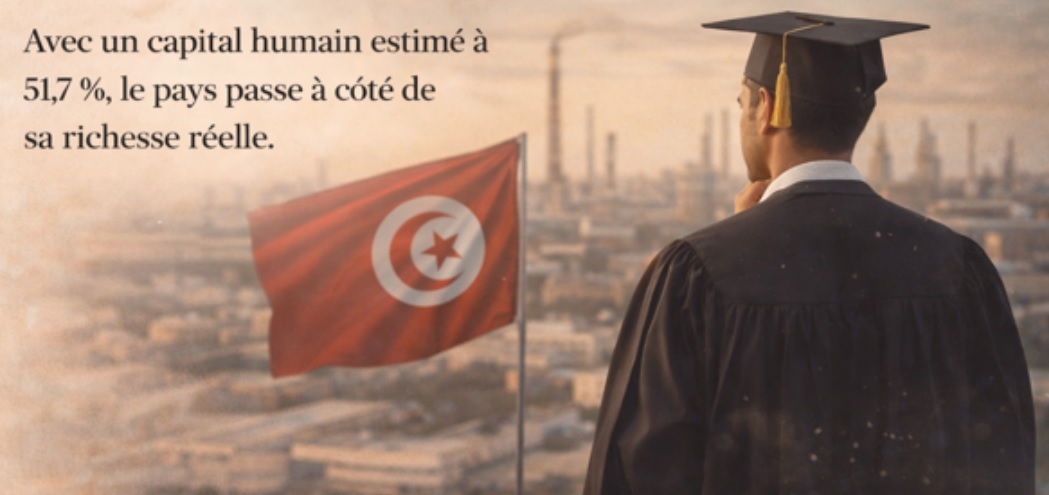
One of the most revealing indicators is human capital. With a score of 0.517 out of 1, Tunisia stands at the average level of upper-middle-income countries, above many African states, but still far from the standards of the most dynamic emerging economies.
In practical terms, this means that a child born today in Tunisia will realize only a little over half of their productive potential in adulthood.
This gap is far from trivial: it represents a massive loss of future wealth, invisible in public accounts but very real in the country’s growth trajectory.
This assessment contrasts with several undeniable achievements. Access to electricity is universal, reaching 100% of the population, while nearly 72% of Tunisians use the internet, a high rate by regional standards.
Life expectancy, at around 77 years, also confirms the relative strength of the social system. In addition, institutional capacity, measured by a statistical performance index of 75.5 out of 100, suggests an administrative system capable of producing and using reliable data.
However, these strengths are not enough to offset structural weaknesses. The country struggles to attract foreign investment, which represents only about 1.5% of GDP, a low level for sustaining strong growth.
By contrast, diaspora remittances reach nearly 6% of GDP, revealing growing dependence on external inflows to maintain economic balance. This contrast highlights a model that relies more on external financial flows than on internal productive dynamics.
An “embryonic” energy transition
Environmental constraints further reinforce this picture. Tunisia uses nearly 92% of its available water resources, one of the highest levels globally, signaling critical pressure on a key production factor.
At the same time, the energy transition remains embryonic: renewables excluding hydropower account for only about 2.7% of the energy mix, well below international standards.
Overall, these indicators do not describe a country in crisis, but rather a chronically underperforming economy.
Tunisia has the foundations of a relatively inclusive model and real human capital, yet fails to fully leverage them. The gap between its capabilities and its outcomes is now its main constraint.
More than cyclical imbalances, this mismatch raises a fundamental question: how to convert potential into value. As long as Tunisia’s economy does not better align education, investment, and production, it will continue to operate below its potential, resulting in growth too weak to meet the social expectations it has itself helped create.