You can line up reassuring statements, multiply flattering indicators, and remind everyone that Tunisia remains an upper-middle-income country.
But at the end of the chain, at the neighborhood market, the supermarket checkout, or when paying the electricity bill, the reality is quite different.
In Tunisia, there is an almost structural gap between macroeconomic indicators and the daily experience of households. Statistics sometimes show nominal increases, reports highlight relative stability, but inside homes, the reality is different: purchasing power is eroding.
The latest note from the Arab Institute of Business Leaders (IACE) puts numbers to a discomfort that households have felt for years: purchasing power has weakened structurally.
This most recent note confirms that assessment. It is based not on perception but on measured data.
A clear and quantified loss
The first key figure in the report is unambiguous:
Purchasing power is estimated to have declined by around 8% over the period 2018–2024.
This decrease, measured through the evolution of real income per capita, means that nominal income growth is not enough to offset inflationary pressure.
The mechanism is simple: salaries rise, prices rise faster, and real income falls.
The IACE notes that “the inflation rate has increased faster than the unit wages paid to households.” This is the classic “scissors effect” seen in economies under pressure: an apparent statistical improvement, but a real deterioration of purchasing power.
Impoverishment reflected in spending patterns
An economic indicator doesn’t lie: it’s the composition of household budgets.
The report notes that “the share of spending on food is rising again, which is a classic indicator of impoverishment.”
In a healthy development trajectory, the proportion of household spending on food decreases relative to income. When it rises, it indicates that households are concentrating their resources on essential needs, discretionary spending margins shrink, and domestic investment capacity weakens.
Housing and healthcare also absorb a growing portion of budgets, increasing the rigidity of mandatory expenses.
The silent collapse of savings
The most concerning point in the report concerns household savings capacity.
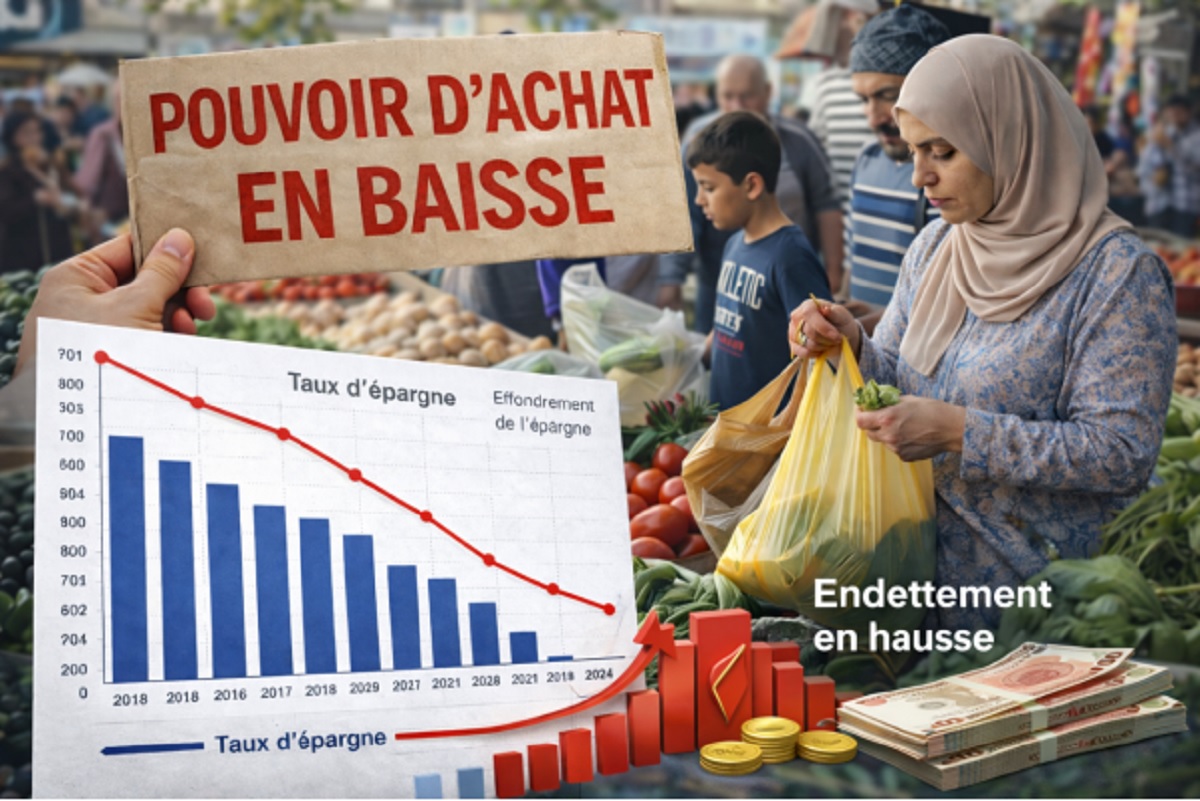
The IACE observes a dramatic drop: “Household savings capacity has contracted sharply, from 8.6% in 2021 to 2.5% in 2024.”
This is not anecdotal; it reflects a profound transformation in the financial structure of households.
Savings normally serve three key roles: a buffer against shocks, a source of investment, and an indicator of economic confidence. A near-drastic contraction means that household financial security has been severely reduced.
Credit as a substitute for savings
When savings disappear, the system finds a compensatory solution: debt.
The report explicitly notes that this contraction “mechanically leads to increased reliance on debt to maintain consumption levels.”
In other words, the stability of household consumption is no longer financed by accumulated resources but through borrowing.
This model carries a structural risk. Current consumption relies on future commitments, financial vulnerability rises, dependence on the banking system intensifies, and the balance becomes fragile.
Beyond the figures
The IACE report does more than diagnose the problem; it identifies levers for correction: streamlining distribution channels, improving competition, reducing economic inefficiencies, and combating distortions and rents.
The goal is clear: restore purchasing power through structural improvements in market functioning. This is not a short-term approach but an institutional transformation.
In conclusion, the IACE report documents the Tunisian paradox: nominal incomes may rise even in a permanently strained economy, but if inflation grows faster and savings collapse while credit becomes a substitute for financial security, purchasing power declines.
The issue is no longer merely statistical, it is strategic. A society where households consume the future to sustain the present cannot guarantee long-term economic stability.
A Quiet but real decline
Between 2018 and 2024, real income per capita fell by approximately 8%. Nominal wages may have increased in some areas, but once adjusted for inflation, these gains disappear.
The accompanying histogram makes this clear: the real income index, based on 100 in 2018, gradually slips to 92 in 2024. A slow, almost imperceptible decline year after year, yet relentless over time.
It is not a spectacular collapse. It is worse: it is a continuous erosion.
While the prices of food, housing, and healthcare rise, incomes struggle to keep pace. The increasing share of household budgets spent on food is a classic indicator of relative impoverishment. The more income devoted to basic needs, the less remains for investment, savings, or simply breathing room.
The Collapse of savings: The alarm bell
But the real warning signal is not just in income—it is in savings.
The curve published alongside is unequivocal: the household savings rate, which reached 8.6% in 2021, plummeted to 2.5% in 2024.
This is not a simple cyclical fluctuation. It is a loss of capacity to absorb shocks.
When savings disappear, vulnerability rises. The slightest unexpected event, illness, job loss, sudden price hikes, becomes a domestic crisis. The response? Consumer credit. In other words, households are consuming tomorrow’s income today.
An economy where households dip into savings or take on debt to maintain their living standards is not an economy in balance. It is an economy under strain.
The Tunisian paradox
We face a paradox: macroeconomic indicators are brandished to reassure lenders, while microeconomic realities weaken households.
The IACE report is neither catastrophist nor naively optimistic. It emphasizes the need for structural reforms: streamlining distribution channels, improving market efficiency, and combating rents and inefficiencies.
Purchasing power is not decreed—it is built through productivity, fair competition, fiscal transparency, and monetary stability.
A social question before a statistical one
Beyond curves and histograms, the issue is social.
A middle class seeing its savings vanish and real income contract becomes cautious, then worried, then distrustful. This shift is measured not only in percentages but in trust.
An economy without trust is an economy at a standstill.
The debate on purchasing power should not be reduced to a political slogan. It has become the central indicator of the country’s economic health.
The question is no longer whether households feel the pressure—the numbers confirm it.
The real question now is: how much longer can they absorb it?
Summary of a Note produced by the IACE on “Improving Household Purchasing Power”