The Central Bank of Tunisia (BCT) published its monetary and financial indicators on Friday, May 8, 2026. The figures show that cumulative Workers’ remittances reached 2.9 billion dinars during the first four months of 2026, marking a 5.2% increase compared to the same period in 2025.
This highlights the importance of this financial lifeline for Tunisia’s crisis, hit economy and it is far from the only one.
According to World Bank data published by Visual Capitalist in April 2026, remittances sent by expatriate workers accounted for a global average of just 0.82% of GDP in 2024. Behind this average lies a deeply unequal reality, where a small group of countries depends on its diaspora as a genuine economic lifeline.
The global leader is Tajikistan, where remittances represent 47.89% of GDP. Nearly one out of every two dollars produced in the country comes from money sent from abroad.
Lebanon follows with 33.35%, then Nicaragua with 26.64%, and Nepal with 26.23%.
These figures describe economies where the state, industry, and local labor market simply cannot sustain the population without support from citizens living abroad.
47th out of 194
Tunisia ranks 47th globally (out of 194 countries, including 17 unranked), with remittances amounting to 6.34% of GDP in 2024. Taken alone, this figure may seem modest. In context, however, it tells a different story.
Tunisia stands well above the global average, ahead of Ukraine (6.29%), behind Jordan (8.31%) and Morocco (7.79%), and in the same category as Bangladesh or Sri Lanka, economies where mass migration is a structural reality rather than a temporary phenomenon.
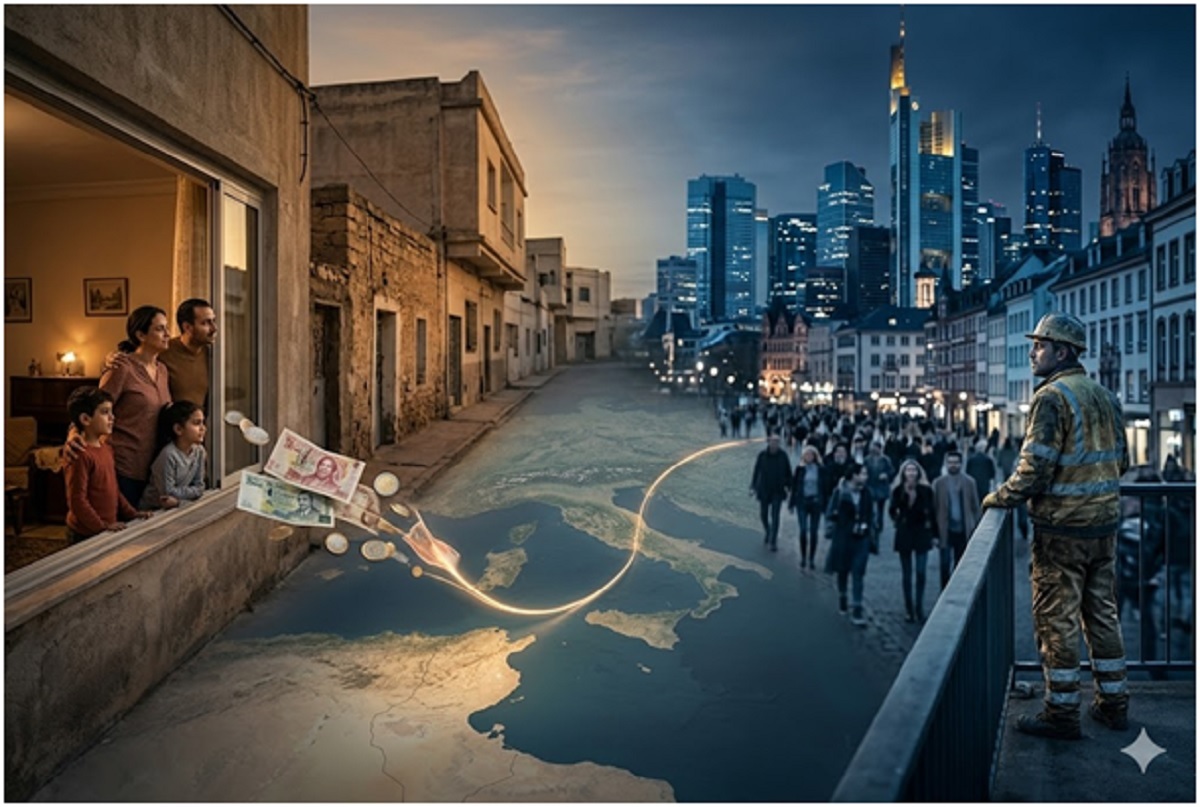
What this figure reveals about the Tunisian economy is less flattering than it may appear. Remittances do not fall from the sky; they are the direct product of large-scale emigration, driven by low local wages, a domestic labor market unable to absorb graduates, and insufficient industrialization to retain skilled workers.
The money sent by the diaspora is used primarily to cover daily consumption, housing, healthcare, and education for families who remain in the country. It does not create productive capacity. It compensates for a weakness without correcting it.
A Tunisia “dependent on remittances”
The comparison with Morocco and Jordan is particularly instructive. Both countries post slightly higher ratios than Tunisia, but they also have active diaspora engagement policies, dedicated investment mechanisms, and strategies aimed at channeling remittances into productive projects.
In Tunisia, this dimension remains largely underdeveloped. Remittances arrive, support consumption, and help stabilize the balance of payments, but they are not integrated into a structured development strategy.
The risks are twofold and well documented. On one hand, dependence on remittances exposes the Tunisian economy to external shocks beyond its control.
The Tunisian diaspora is concentrated mainly in France, Italy, and Germany. A slowdown in the European labor market, stricter immigration policies, or rising transfer fees could quickly and unexpectedly reduce these flows.
On the other hand, this steady inflow acts as a kind of anesthetic. It eases pressure for structural reforms, delays the urgency of a serious industrial policy and masks local productive weaknesses behind an appearance of macroeconomic stability.
A “Parallel Central Bank”
The world’s major economies illustrate this paradox by contrast. India receives remittances equivalent to 3.5% of GDP, Mexico 3.6%, and the Philippines 8.7%. These countries receive far larger absolute amounts than Tunisia, but their diversified economies dilute the relative impact. Tunisia’s dependence at 6.34%, within a relatively small economy, is therefore more significant than it may first appear.
For Tunisia, the diaspora has become, in the words of Visual Capitalist, a genuine “parallel central bank.” It stabilizes, cushions, and finances the economy. But it cannot replace economic policy.
And unlike a central bank, it answers to no national governance decisions. It follows its own logic, that of families, foreign labor markets, and the migration policies of countries over which Tunis has no control.