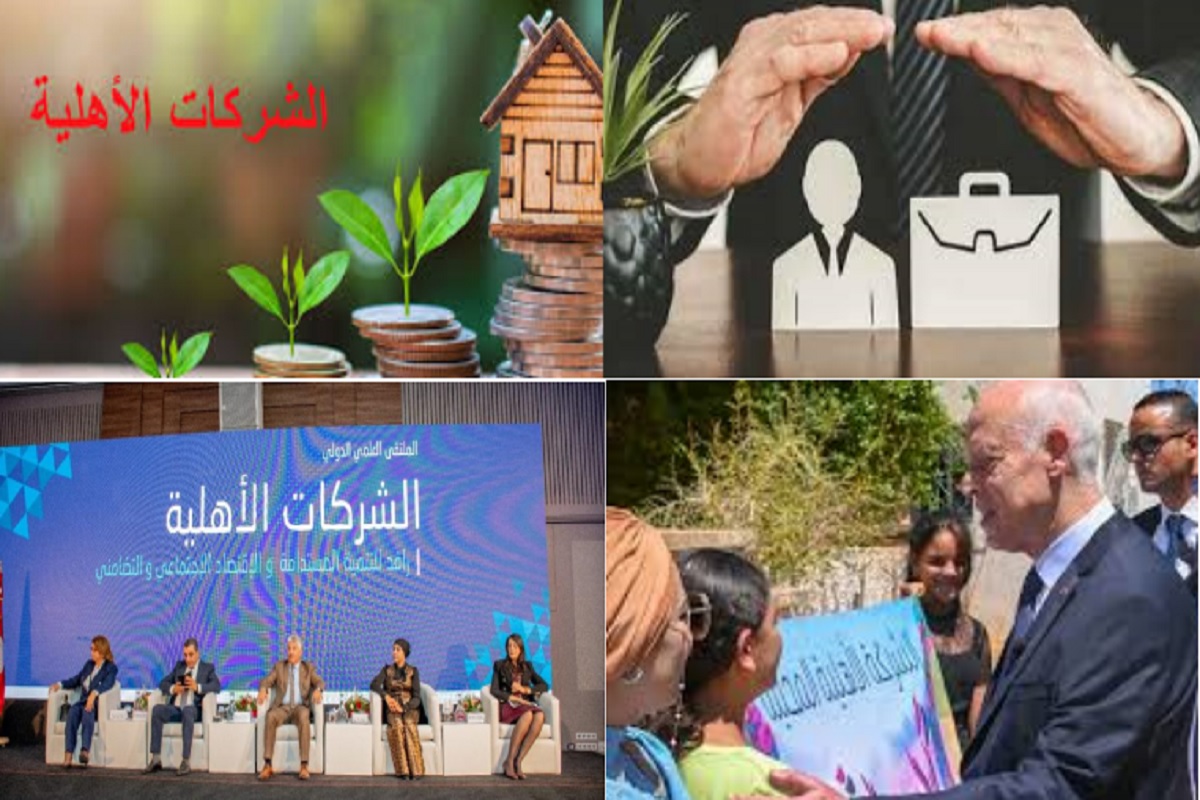
The Tunisian head of state is creating a new breed of entrepreneurs, a wealthy class, increasingly made rich by other people’s money. The latest cabinet reshuffle introduced the post of Secretary of State for Communitarian Enterprises, with measures and statements aimed at giving them every advantage to thrive.
And apparently, nothing is too generous for these entities, tax exemptions are already on the table.
What is a “Communitarian”?
This new form of entrepreneurship, launched under Decree 15 of 2022, “relies on collective initiative and social benefit.” It is a legal entity formed by a group of local residents and is meant to promote social justice and equitable wealth distribution through collective economic activity within its territorial area.
Communitarian enterprises operate under strict rules: each investor holds only one share and one vote, regardless of capital contribution. They must have a minimum of 50 shareholders, who must be registered voters and can be either local (capital ≥TND 10,000) or regional (capital ≥ TND20,000).
Shareholders must be apolitical and cannot rely on donations. Profits are residual, distributed after operational costs.
Registration with the National Business Register (RNE) is mandatory and financial statements are audited by certified accountants accountable to the public prosecutor, though bound by confidentiality.
Importantly, struggling companies under Law 95 can also become communitarian, opening their capital to new participants. These enterprises are directly overseen by the regional governor and the Ministry of Economy and Planning.
Unprecedented privileges
According to the Ministry of Employment, 85 communitarian enterprises are registered with the RNE, 68 regional and one local.
Under Article 92 of the decree, they are exempt from all taxes and levies for 10 years from incorporation. Yet, a communitarian enterprise can be dissolved if two-thirds of shareholders agree or it loses ¾ of its capital, after which the same individuals can start a new one.
In September 2024, the Secretary of State for Communitarian Enterprises exempted them from environmental impact studies, normally required to secure investment declarations. Another perk: a monthly subsidy of TND 800 per enterprise, paid into the company’s accounts as working capital, not to shareholders.
Recently, the BTS bank, a Tunisian solidarity bank, committed to granting loans up to TND 300,000 without guarantees to communitarian enterprises. Following a commercial code revision in July 2025, all Tunisian banks must allocate 8% of annual profits (nearly TND 100 million) as interest-free, unsecured loans to SMEs, including communitarian enterprises.
Inequality and controversy
The government is effectively creating a new class of privileged businesses, funded by other people’s money and competing with fully taxed companies. Meanwhile, some bankers remain in prison for issuing unsecured loans, while communitarian enterprises receive guarantee-free, interest-free credit, potentially gaining an unfair advantage over existing companies.
In short, Tunisia now has a new entrepreneurial caste: heavily subsidized, largely untaxed and poised to compete with traditional businesses, raising questions of fairness and the sustainability of this model.