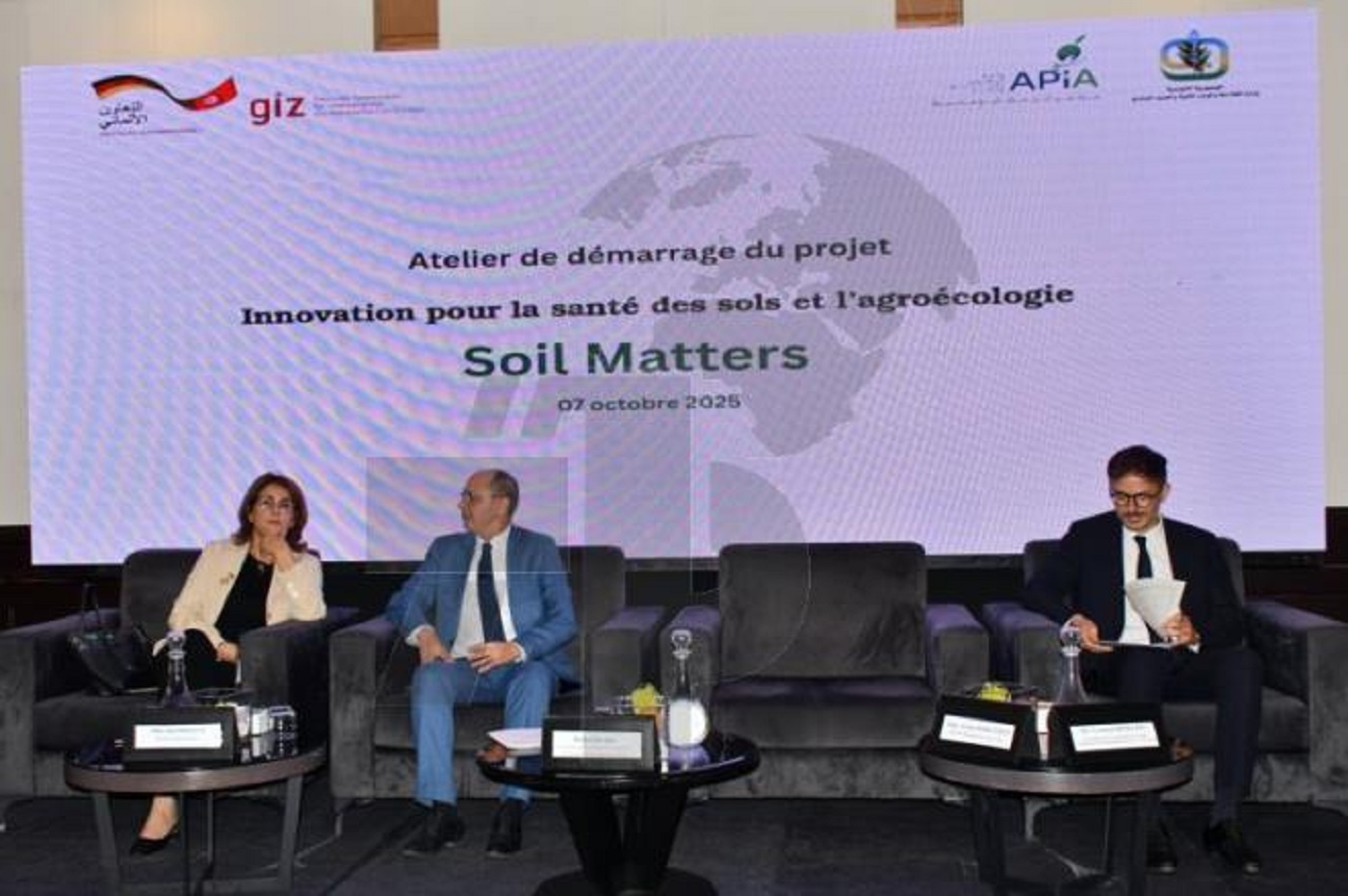
The activities of the project “Soil Matters: Innovations for Soil Health and Agroecology”, with a budget of €2.3 million (approximately 7.8 million dinars), officially started on Tuesday in Tunis.
Financed by the German Federal Ministry for Economic Cooperation and Development (BMZ), Soil Matters will be implemented by the Agency for the Promotion of Agricultural Investments (APIA) and the German Agency for International Cooperation (GIZ) until April 2028.
The goal is to scale up innovations favorable to soil health and agroecology, relying in particular on the engagement and capacities of the private agricultural and agri-food sector.
Specifically, Soil Matters will improve the capacities of 2,000 farmers, 18% of whom are women, and apply innovations in soil health and agroecology on 3,000 hectares, stated the project manager, Soumaya Belhadj Slimane.
Speaking at the Soil Matters project kick-off workshop, she emphasized that the project will allow the adoption of seven planning or policy instruments promoting soil health and the scaling up of services or products for soil health and agroecology in 10 MSMEs and economic groups.
The project leader stressed that Soil Matters is organized around three axes. The first is strengthening organizational, technical, and commercial capacities of companies to adopt and implement innovations for soil health and agroecology.
The second component focuses on improving the enabling conditions for the adoption of agroecological practices by economic actors, while the third revolves around capitalizing and sharing lessons from experiences and supported innovations through national, regional, and international networks.
For Haykel Hochlef, Chief of Staff to the Minister of Agriculture, soil preservation is not an option but rather an essential condition for sustainable agriculture.
Agriculture occupies a central place in the national economy and is a strategic lever for growth, employment, and social stability, as well as a vector of food security and a key pillar of sustainable natural resource management, he stressed.
However, the country faces major challenges, such as climate change, increasing water scarcity, and worrying soil degradation, which weakens ecosystems and affects agricultural productivity, he deplored.
In this regard, he recalled that organic matter content does not exceed 2%, about 1.5 million hectares of land are affected by salts, and 23,000 hectares of productive land are lost each year due to erosion.
These trends endanger soil fertility, farm profitability, investment in the agricultural sector, and food sovereignty, he said.
He stressed that the project has particular importance through an integrated, innovative approach based on two essential levers: agroecology and technological innovation.
He specified that the project aims to promote investment related to soil conservation practices capable of regenerating organic matter, strengthening ecosystem resilience, and widely disseminating agroecology practices to reduce dependence on chemical inputs and strengthen the capacities of agricultural actors (researchers, engineers, technicians, and farmers).
Soil Matters is part of the special initiative of the German Federal Ministry for Economic Cooperation and Development (BMZ) for transforming agri-food systems (AGER), whose objective is to enable everyone to enjoy the right to safe, sufficient, and balanced food.
Soil Matters Tunisia is part of the global Soil Matters program, with a total budget of approximately €20 million, which will also be deployed in six countries: India, Kenya, Ethiopia, Madagascar, and Cameroon.