A cost line that says it all
There is, in the profit-and-loss statement of the Central Bank of Tunisia (BCT), a line item that most readers overlook: the cost of printing banknotes and minting coins.
Yet it is the only indicator in the balance sheet that reflects, without statistical mediation or methodological bias, the real physical demand for cash in the economy. And what this item reveals for fiscal year 2025 is striking.
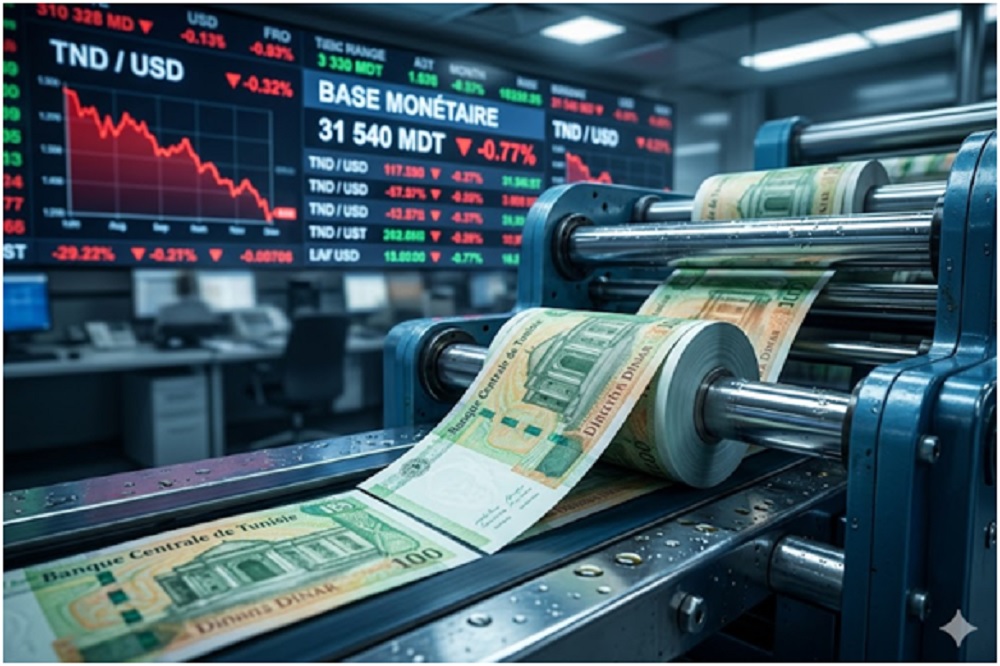
According to the latest financial statements of the BCT, the issuing institution spent more than 28.763 million dinars in 2025 alone on printing banknotes and coins, compared with 9.316 million dinars the previous year.
That represents a +209% increase in one year, the sharpest rise in any expense category in 2025. Literally and figuratively, the money printer has been running and fast.
Four years of data, a clear trajectory
To understand this figure, it must be placed within the 2022–2025 four-year series, which shows a deep and non-linear evolution.
The 2023 paradox: the illusion of discipline
This is the most misleading point in the series. In 2023, printing costs collapse to 3.9 million dinars, a drop of 82.6%. A quick reading might suggest monetary stabilization. That would be a fundamental misinterpretation.
Three elements documented in the financial statements contradict this reading. First, banknotes in circulation continue to rise by +10.7% despite near-zero printing costs: if nothing is printed while supply increases, it means the central bank is drawing on the stock built up in 2022, when 22.4 million dinars were invested in production.
The stock absorbs demand without appearing in the income statement.
Second, the growth rate of currency in circulation is already accelerating year-on-year, from 9.2% to 10.7%: the signal is there, invisible in costs but present in dynamics.
Finally, advances granted to the State fall from 1.9 to 1.4 billion dinars thanks to a 500 million dinar repayment in December 2023, creating an illusion of fiscal disengagement.
It is only a postponement: by 2024, these advances jump to 7.6 billion dinars, a +442% increase in a single year.
Thus, the 2023 accounts are the most misleading to interpret: low costs, partial repayment, and apparent state withdrawal create a façade of discipline that actually masks a silent accumulation of monetary pressure.
2024: the silent turning point
The real turning point is not 2025 but 2024 and precisely for that reason, it is difficult to detect. By multiplying state advances by 5.4 in one year, the BCT crosses a threshold whose effects only appear in visible balance-sheet items with a one-year delay.
Currency in circulation temporarily slows to +8.4% because the 2022 stock still absorbs demand. The balance sheet appears under control. It is no longer.
This gap between monetary decisions and their reflection in printing costs is one reason central bank balance sheets are so difficult for the public to interpret: the effects of one year are never fully visible within that same year.
2025: the materialization
In 2025, the effects of phase two appear across all indicators simultaneously. Currency in circulation rises by 19%, printing costs triple, net income falls for a second consecutive year (−15.4%) and claims on the State represent more than 24% of the institution’s total balance sheet.
The most revealing signal is not the absolute cost level, but the composition of banknotes being produced. The 50-dinar note, which accounted for 13.2% of circulating cash in 2022, rises to 32.8% in 2025, an average annual increase of +52.5% over three years.
This shift toward higher denominations is a behavioral marker of inflation: economic agents require higher-value notes to conduct the same transactions. This is not inference; it is reflected in the structure of orders placed by the BCT with printers.
“This item records the outstanding facilities granted to the State, on an exceptional basis, to finance part of the budget deficit. These facilities were granted in accordance with Article 5 of the 2020 Finance Law, Law 2024-10 of February 7, 2024 and Article 12 of Law 2024-48 of December 9, 2024.”
The decoupling between official inflation and monetary pressure
In 2025, the monetary base grew by +19% while official inflation stood at around 4.8%. The 14.2-point gap suggests two non-exclusive explanations.
The first is informal-sector absorption. A significant share of newly issued dinars circulates in the informal economy, estimated at around 35–40% of Tunisia’s GDP, outside the consumption baskets used by the national statistics institute.
The surge in demand for 50-dinar notes (+49.2% in 2025) is consistent with this: these are the preferred denominations for high-value informal transactions.
The second is deferred inflationary pressure. Regulated prices, fuel, flour, electricity, absorb part of monetary pressure through subsidies, mechanically lowering the official CPI.
When these subsidies are eventually reduced or removed, as is likely in any medium-term adjustment program, the latent pressure will be released, not gradually but in a concentrated manner.
What four years reveal together
The 2022–2025 sequence describes a three-phase transition. The first phase (2022–2023) is a contained crisis-management period, where traditional tools still function and the balance sheet gives the illusion of control.
The second phase (2024) is the silent tipping point: decisions are made, but effects are not yet visible. The third phase (2025) is the moment of materialization, when all indicators move in the same direction at once.
The cost of printing banknotes is not just another accounting line. It is the only item in a central bank’s income statement that directly reveals, without methodological distortion, the physical demand for money in the real economy.
Its four-year trajectory is, in this sense, the most honest signal the BCT balance sheet can offer, provided it is properly read.