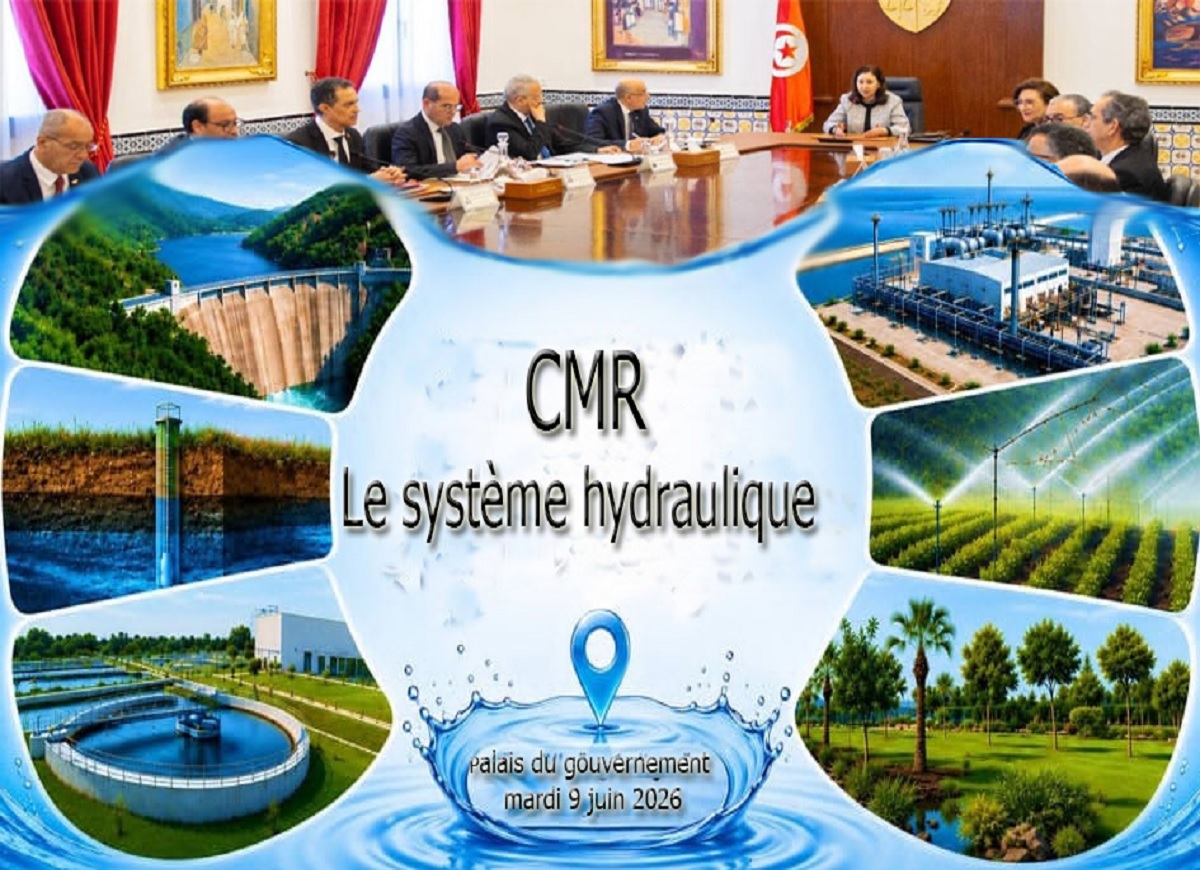
Under the hot skies of early June (between 28°C and 33°C on Tuesday, June 9, 2026) and in a heavily air-conditioned room in Kasbah, the Tunisian government chose to reopen the water issue.
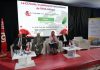
On Tuesday, June 9, 2026, Prime Minister Sarra Zaafrani Zenzri chaired a small cabinet meeting dedicated to the country’s water system, attended by Minister of Agriculture, Water Resources and Fisheries Ezzeddine Ben Cheikh and Secretary of State for Water Hamadi Habaieb.
The official message was clear: Tunisia will not face a shortage of drinking water this summer.
A 58-million-dinar emergency program
The meeting approved a summer program comprising 81 projects worth 58 million Tunisian dinars (TND), including 35 projects already underway. The plan includes drilling and connecting 38 deep wells, maintaining 26 pumping stations and carrying out work on 22 water network projects.
In addition, 187 hydraulic systems serving 248,000 residents will be accelerated at a cost of 147 million dinars. Twenty water tankers have also been allocated to mountainous regions.
Better-filled dams, but less autonomy than It appears
According to La Presse de Tunisie on June 3, overall dam filling rates exceed 60%, with reserves estimated at 1.4 billion cubic meters.
Since the beginning of the season, cumulative inflows have reached 1.6 billion cubic meters despite rainfall being 25% lower than in 2025, though more evenly distributed. Water expert Houcine Rhili estimates a surplus of around 500 million cubic meters compared to last year.
The situation remains uneven across regions. The Cap Bon region records more than 90% filling, northern Tunisia stands at 68%, while central Tunisia remains at only 13%.
Although 1.4 billion cubic meters appears reassuring in absolute terms, the picture changes when compared to consumption. Based solely on drinking water needs and SONEDE’s daily production rate of 1.86 million cubic meters, reserves would theoretically cover 751 days. However, dams also supply irrigation, industry, and tourism. Considering their traditional allocation between drinking water and agricultural use, actual autonomy amounts to roughly one year of withdrawals, excluding evaporation losses.
Evaporation alone consumes between 10% and 15% of stored water annually, representing 140 to 210 million cubic meters lost before any use.
Four desalination plants: How much do they really contribute?
SONEDE currently operates four major desalination plants.
Zarat (Gabès), commissioned in 2024, produces 50,000 cubic meters per day, expandable to 100,000, serving Gabès, Médenine, and Tataouine.
Djerba has a similar capacity of 50,000 cubic meters per day.
Sfax, the country’s largest desalination plant, produces 100,000 cubic meters per day, expandable to 200,000, following an investment of 780 million dinars.
Sousse, operational since spring 2025, supplies 50,000 cubic meters daily.
Tenders have already been launched for desalination projects in Tozeur, Kébili, Sidi Bouzid, and Ben Guerdane, while feasibility studies are underway for Mahdia and Zarzis.
The four operational plants have a combined nominal capacity of 250,000 cubic meters per day, equivalent to approximately 91 million cubic meters annually at full capacity. Compared to Tunisia’s annual drinking water consumption of 680 million cubic meters (official 2024 figures), this represents about 13% of national demand.
Actual output, however, is lower due to maintenance interruptions, such as the shutdown of the Zarat plant between April 13 and April 23, 2026. Effective production is estimated at around 10–11% of national consumption.
While this marks significant progress, it is far from the comprehensive solution it is sometimes portrayed to be. The government’s objective remains to reach 30% by 2030.
A year of reassuring official statements
Since May 2025, public officials have repeatedly sought to reassure citizens. At that time, SONEDE stated that “there would be no water cuts this summer.” In March 2026, Hamadi Habaieb declared from Sousse that “the summer season looks more promising than in previous years.”
On June 9, the cabinet meeting reaffirmed its commitment to ensuring drinking water supply for all and preventing service interruptions.
The “Thirst Map” tells a different story
The Tunisian Water Observatory (OTE) recorded 302 citizen alerts during May 2026 alone, including:
266 unannounced water cuts,
12 protest movements demanding access to water,
15 reported leaks.
The governorate of Ben Arous topped the list with 26 alerts, followed by Gafsa (25), Kasserine (23), and Tunis (22).
According to Houcine Rhili, Sfax experienced 230 water cuts in 2025 despite having a desalination plant, while Ariana recorded more than 100 interruptions. Water shortages are no longer caused solely by scarcity.
Aging infrastructure, power outages affecting pumping stations, and inadequate maintenance have become major factors. On May 26, 2026, the day before Eid al-Adha, SONEDE itself urged citizens to postpone certain water uses after 6 p.m.
A network leaking from every side
SONEDE serves 3.3 million subscribers through a network stretching 59,000 kilometers, of which approximately 20% is considered obsolete. The current renewal program aims to replace 1,000 kilometers annually, meaning it would take more than a decade to modernize the existing aging infrastructure.
The June 9 cabinet meeting also approved measures to improve network efficiency and deploy smart water meters.
The 2050 strategy: The long-term vision
Tunisia’s National Water Strategy to 2050 mobilizes 74.515 billion dinars through four strategic pillars, 43 programs, and 1,200 measures. Some 53% of the budget is allocated to non-conventional water resources and network efficiency improvements.
Meanwhile, the 2026–2035 energy transition program includes 225 megawatts of photovoltaic power plants, aiming to reduce the energy cost of the water cycle from 27% in 2025 to 17% by 2030.
Between the promise and the tap
Summer 2026 will be the real test. Dams are better supplied, four desalination plants are operating, and the government has secured a 58-million-dinar emergency program. Yet the experience of the past year shows that healthy water reserves do not necessarily prevent taps from running dry in neighborhoods where infrastructure fails.
The political promise looks solid on paper. Its success, however, will ultimately be measured by what flows from citizens’ taps and by the monthly “Thirst Map” published by the Tunisian Water Observatory.