This is an initiative from which higher education graduates may legitimately expect progress in gaining access to the international market.
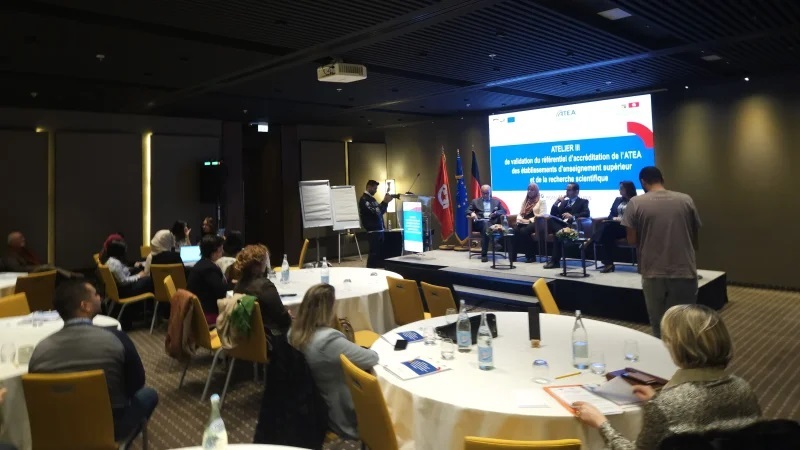
It is the project for an Accreditation Framework for Higher Education and Scientific Research Institutions, which was discussed during a workshop organized at the initiative of the Tunisian Evaluation and Accreditation Agency (ATEA), under the Ministry of Higher Education and Scientific Research.
The workshop aimed to discuss the project in order to strengthen Tunisia’s higher education and scientific research quality assurance system through a participatory approach, bringing together ATEA stakeholders to ensure collective ownership of the framework and enhance its relevance to the Tunisian context.
ATEA Director General Salma Dammak stated that the framework seeks to improve the quality of academic programs, optimize the international positioning of universities, strengthen recognition of Tunisian degrees and support graduates’ employability.
She told TAP that this draft framework is a first for Tunisia, given the absence until now of a dedicated national mechanism.
She added that, initially, participation in the process will remain voluntary and will be undertaken at the request of the institutions concerned, which will undergo a full external evaluation before any decision is made.
The framework covers all aspects of university life, including governance, program design, alignment with employment prospects, exam organization, as well as student living conditions and housing.
Launched in 2024, its development will continue throughout 2026 to incorporate the necessary adjustments, before entering a pilot phase in a limited number of institutions, with a view to later generalization. Its final adoption is expected by the end of the year, she said.
She also stressed that improving the quality of higher education cannot rely solely on the ministry’s budgetary resources and requires complementary support mechanisms, such as assistance programs that have enabled several institutions to secure additional funding to strengthen their management and infrastructure.
Improving the ranking of Tunisian universities
For his part, Ali Mtiraoui, chairman of the agency’s scientific committee, said the workshop aims to review the preliminary version of the framework with stakeholders and gather their feedback in order to finalize the text and launch the pilot phase in three or four institutions.
He noted that accreditation, although optional at this stage, is of strategic importance as it facilitates access to the international market, improves university rankings, and promotes students’ professional integration.
He explained that the evaluation will be based on ten main pillars, covering in particular institutional strategy, teaching quality, program compliance, research and scientific publication, support services, student life and social responsibility.
Once an application is submitted, the Agency will conduct an external audit, which will result either in the awarding of the label or in recommendations for improvement prior to re-evaluation, according to the same source.
Established in 2022, ATEA is working to put in place the country’s first national accreditation system in line with international standards, with support from the European Union through the PASE program, led by the German cooperation agency (GIZ).