Nabeul, the ultimate summer town, is once again bringing seasonal wealth to the people of Nabeul, with thousands of dinars to be earned from a week’s rental.
Tour operators’ buses clutter the pavements and abandoned supermarkets are not even being used as temporary car parks. Advertisements for ‘villas and studios to rent’ are scrawled on every wall.
Nabeul is the ultimate summer town. Tour operators’ buses clutter the pavements, abandoned supermarkets are not even used as temporary car parks and advertisements for ‘villas and studios to rent’ are scrawled on every wall.
Once again, the town is bringing seasonal wealth to its people, who can earn thousands of dinars from a week’s rental. It is, however, a city that becomes a dormitory town in winter.
It is a city where anything goes on roads and railways
The two roads leading from Hammamet are almost like racetracks and rodeo grounds for big motorcycles, which roar without restraint despite the National Guard post at the exit.
The officers inside the post can only be seen, and the former presidential police crossroads of the former ZABA residence is now just a district that closes at weekends.
There are high-speed car races on a road lined with houses on both sides. There are also unbridled motorcycle races on the tourist road, which has become a fitness trail used by almost everyone in Nabeul.
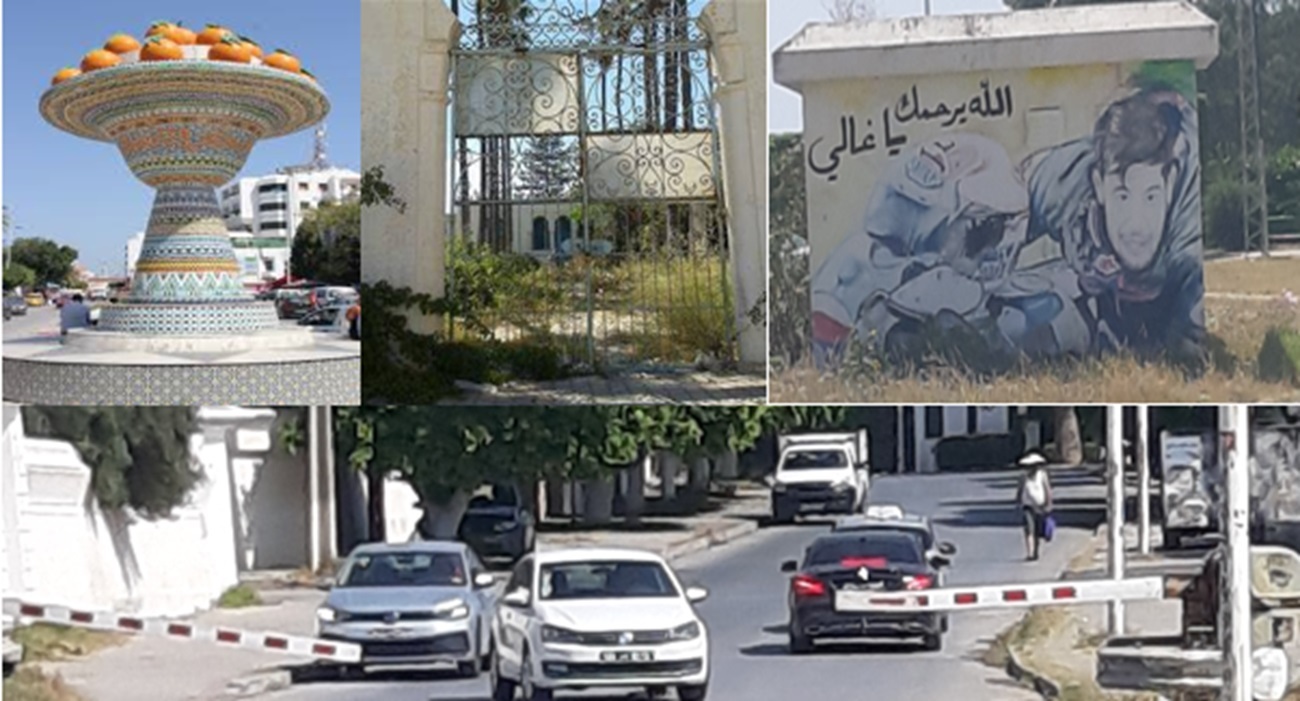
Yet it is on this tourist road that frescoes commemorating two young motorcyclists from the city who were killed in accidents can be found. The memorial is still there, but the memory of the accidents has clearly disappeared.
The tourist road is crossed by the abandoned railway line of Nabeul. It is an abandoned line belonging to the SNCFT, with weeds growing rampantly and large clumps of dry thistles, palm tree debris and rubbish littering the pavements. The area is at risk of catching fire at any moment, either due to the blazing sun or a carelessly discarded cigarette butt.
This site should have been maintained by the SNCFT as part of their environmental protection measures. They could have turned it into a grassy area or even a flower garden. But that would be too much to ask of the SNCFT, whose level crossings frequently break down, resulting in hours of delays due to broken barriers.
Conversely, in other places, the barriers open when the train whistles three times. These breakdowns have caused deaths, with the last two occurring as recently as May.
The history of an entire city lies under a second-hand clothing shop!
The ancient city of Neapolis, whose archaeological sites are either closed to the public or have been overtaken by urban development to the extent that a second-hand clothing shop has been built on top of an archaeological site.
Fortunately, the owner of the shop took care to preserve the remains of ancient Nabeul, placing beams and a large glass window underneath them.
Nabeul, the city of ceramic art objects, has nothing left but “vulgar” pottery that no longer attracts tourists or locals.
Nabeul is theoretically the capital of citrus fruits and the city of large, ugly ceramic tile containers. A few unfortunate oranges hanging there poorly reflect this governorate’s role in national production (approximately 75%) and exports (approximately 90%).
From Dar Laffitte to the artisan and state buildings, everything is falling into ruin amid general indifference.
Nabeul experienced its first historic floods in 2018, caused by torrential rain which caused significant damage and affected many families.
However, it only takes a few storms for the main streets to fill with large puddles, as if the various governors, who have the largest residence in the region and a dangerous, poorly signposted speed bump that almost no one uses, have learned nothing and done nothing.
It is not the rains that threaten the various prestigious buildings, such as “Dar Lafitte” in Nabeul, or the other public building in front of “Dar El Gaïed”, which once housed the DR des Finances and a specialist police unit, that are falling into ruin without anyone taking care of or occupying them.
The same applies to at least two grand hotels in the city centre, close to the governorate and the regional crafts office headquarters, which are in a pitiful state.
It seems that the municipality and the governorate of Nabeul have yet to heed the head of state’s orders to take action against the scourge of ruins!
Luxury villas and dusty, muddy roads
There is indifference to the danger posed by the train that practically divides the city in two. It criss-crosses the city from end to end, making more noise than it carries passengers. It is like a powder keg that could cause another deadly summer.
But the city is also divided in two architecturally. There is Nabeul city, where marriages can no longer be celebrated due to the lack of a mayor, and all the outlying neighborhoods along the famous Rodeo Road, with its big cars and motorcycles, leading to Hammamet.
These are upmarket neighborhoods with villas worth millions of dinars on both sides and unpaved roads, as if tarmac were a privilege reserved for the original inhabitants of Nabeul and as if the municipality did not receive hotel tax and had no money in the coffers.
There is a municipality, but not for everyone
However, one day we saw municipal machinery come and dredge a sewer for three days in a row. This work did not take into account the existence of the villa of a prominent city doctor.
They only dredged the sewer though, and did nothing about the huge potholes that “embellish” the road leading to it.
We also saw other municipal vehicles come to weed a street corner, which was clearly intended to serve as a car park for a few nearby luxury second homes. On the same day, we found a video on social media praising the municipality’s efforts on behalf of its residents.
The beach, which was littered with plastic bottles, nappies, toilet paper and sharp-edged cans, was only a stone’s throw away.
The vehicles had more important things to do than clean up this beautiful beach in Nabeul, which is dotted with private commercial huts. The latest addition is a water sports centre that has quickly claimed part of the sea for itself!
At the start of summer, the shortcomings of the municipal hygiene services in Nabeul are impossible to ignore. Hordes of mosquitoes invade homes, clinging to the greenery which is almost the city’s only distinctive feature.
So far, municipal services have been conspicuous by their absence, as have those responsible for security, road infrastructure, and the environment.
The municipality of Nabeul limits itself to pocketing the fees for installing beach huts without using the money to send in cleaners to tidy up the dirty beaches at least once a week.
Paper and photos were provided free of charge by a Nabeul resident who requested anonymity.