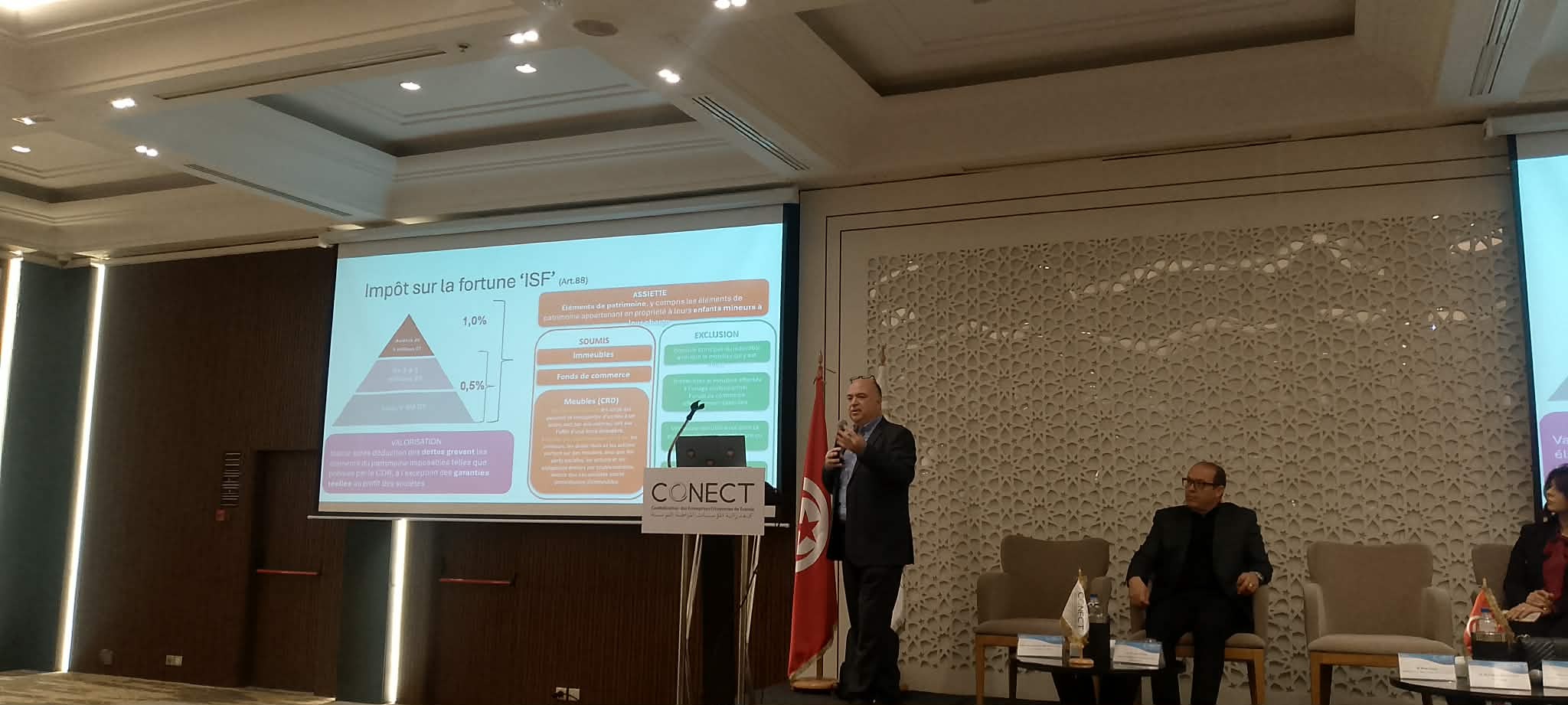
The Confederation of Tunisian Citizen Enterprises (CONECT) is calling for a moratorium of at least six months on sanctions linked to the implementation of Article 53 of the 2026 Finance Law, which concerns electronic invoicing. This demand was made by Mehdi Bhouri, a member of CONECT’s National Executive Bureau.
Speaking to TAP during an information day on the 2026 Finance Law and electronic invoicing held in Tunis, Bhouri explained that companies were caught off guard by the immediate enforcement of this measure.
Article 53 of the 2026 Finance Law expands the scope of electronic invoicing, making it mandatory for service operations, whereas previously it applied only to the delivery of goods and certain specific services.
The law now requires electronic invoices for all services, unlike the previous legal framework, which had a more limited scope.
A phased approach recommended
In this context, Bhouri called for a gradual implementation of the reform, sector by sector, along with a review of pricing to ensure proportionality according to company size and business volume. He also emphasized the need to train and guide economic operators to ensure a successful transition to this new system.
While reaffirming CONECT’s support for the digitization of administration and taxation as a tool for fiscal fairness, Bhouri warned that poorly prepared reforms risk failure.
He noted that the legal framework for electronic invoicing has existed since 2016, but its application has experienced interruptions and restarts, without any public impact analysis.
Referring to an international comparative study conducted by CONECT, Bhouri said that more than 80 countries have implemented electronic invoicing. Successful experiences, he said, rely on gradual implementation, impact studies, and technical readiness, including the platform’s capacity to handle large numbers of companies and prior testing phases.
As an example, Brazil took over ten years to fully deploy electronic invoicing, achieving an estimated 20% reduction in VAT fraud.
“In our case, since 2016, there has been no measured feedback. We do not know the real impact of this measure, and therefore whether it has truly met its objectives,” Bhouri concluded.
Clarifying the affected categories
In the same vein, Faten Baatout, member of the executive committee of the Tunisian Union of Liberal Professions (UTPL), stressed the urgency of clarifying which categories are actually concerned by electronic invoicing.
“We have called for more precision and data from the administration to clearly identify which categories are subject or not, to avoid unjustified exposure to sanctions,” she said.
She also urged the General Directorate of Tax Studies and Legislation (DGELF) to publish an explanatory note as soon as possible, considered essential to help companies and liberal professionals understand the exact scope of the new measure.
“This note is also critical for determining how expenses can be deducted, as companies need to know whether paper invoices remain valid or not,” she added.
According to Baatout, the technical and regulatory conditions are not yet fully in place for the effective application of electronic invoicing, while emphasizing UTPL’s support for transparency and the fight against tax evasion.
Last Monday, President Kaïs Saïed received Finance Minister Michket Slama Khaldi at the Carthage Palace, urging more flexibility in applying electronic invoicing to avoid potential negative impacts on the country’s economic situation.
Following this meeting, the Ministry of Finance issued a statement on Tuesday emphasizing that the provisions of Article 53 regarding electronic invoicing will be applied flexibly.
This approach aims to prevent potential difficulties, particularly in accessing electronic platforms, especially for small and medium-sized enterprises (SMEs) and several other activities, according to the same source.