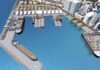
The Ministry of Transport has announced that efforts are underway to propose the classification of the deep-water port project in Enfidha as a public project of strategic importance, with the aim of accelerating its implementation.
In response to a written question from MP Abdelhalim Boussema, the ministry clarified that this procedure falls within the framework of Decree No. 497 dated October 24, 2024, relating to major public projects.
The ministry added that on April 14, the Enfidha Port Company presented the project file to the technical committee of the ministry, before submitting it in May 2025 to the Higher Committee for Major Projects within the Prime Ministry.
Regarding land use, the ministry noted that significant progress has been made in establishing the port complex, which includes a port area and a logistics service zone. It emphasized that regularizing the land status is a key component of the project.
The ministry stated that a proposed execution timeline foresees a five-year period from the start of construction work.
Seen as a strategic project for Tunisia, the port will enable the country to capitalize on its geographic position at the heart of the Mediterranean basin.
It will become a major pillar of the national economy, the ministry stressed, underlining the need for sound decisions to ensure implementation that respects national sovereignty and principles of good governance.
An 11-Year Delay
The Enfidha deep-water port project has been delayed for approximately 11 years, despite the creation of a public company named “Enfidha Port Company,” tasked with completing, developing, and maintaining the port and its adjacent logistics zone, coordinating related transport infrastructure projects, and carrying out the necessary studies and development plans.
Once completed, the port is expected to handle around 4.8 million 20-foot containers, with an operational capacity to generate 52,000 direct and indirect jobs.
The port will meet international standards for quality, safety, and environmental protection. It will also allow Tunisia to connect to major transport hubs between East and West, reducing transit times by up to 10 days, cutting costs by 15%, and attracting part of the transshipment traffic in the central and western Mediterranean.
The port is expected to be completed in two phases by **2030**. The first phase, spanning three years, began in **2023**, and the second phase is set to follow over five years.
Project Components
The project will be carried out in several phases. The first phase will focus on developing the port area, covering 1,000 hectares, followed by the development of the economic and logistics service zone, which will span 2,000 hectares. Initially, 1,200 meters of quays will be built, with the remaining 800 meters to be completed in the second phase.
Additionally, a dry bulk terminal will be rapidly developed opposite the container terminal, covering 560 meters, over an area of 35 hectares, with storage yards capable of handling around 4 million tons.
The total cost of the first phase is estimated at $1.04 billion, with 75% funded by the public sector and 25% by the private sector.