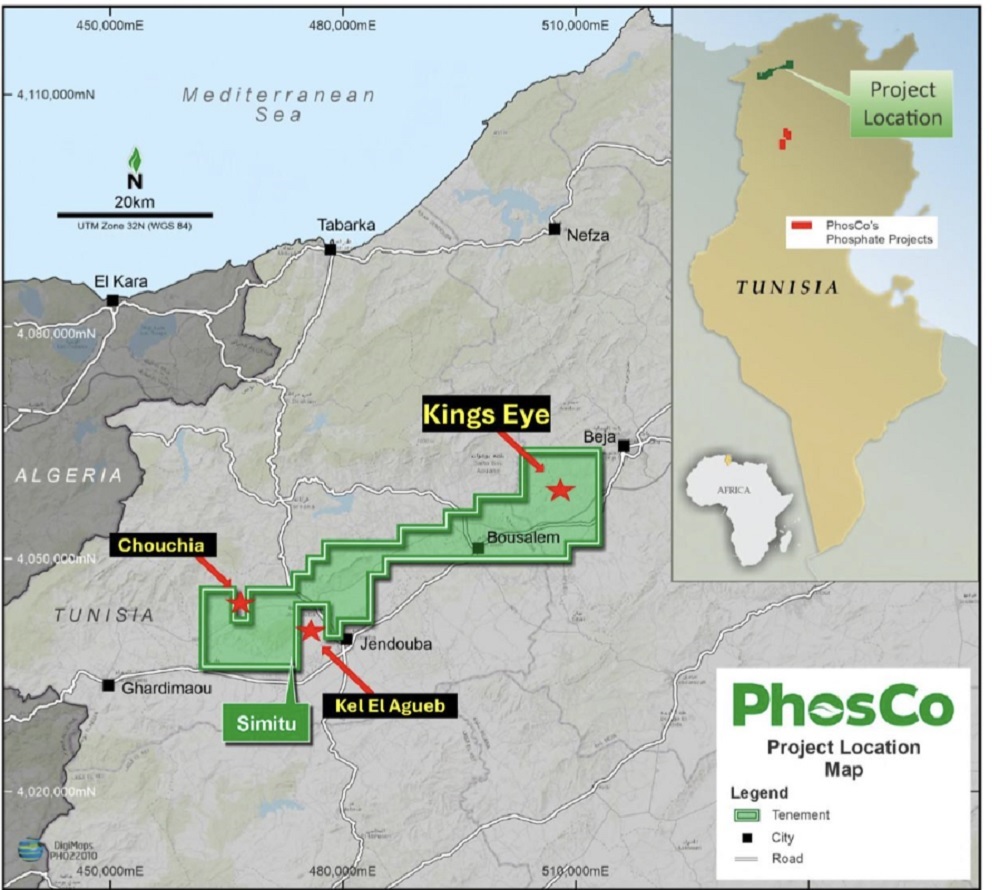
Mining company PhosCo Ltd announced that it has obtained high-quality assay results from selective rock samples taken from the King’s Eye prospect, part of its 100%-owned Simitu project in northwestern Tunisia.
Samples collected from outcrops, old mine workings and mine waste returned grades of up to 21.3% copper and over 100 grams per ton (g/t) of silver, with 21 samples grading above 1% copper and 5 samples exceeding 10% copper.
Copper sulfide mineralization also delivered strong associated results in antimony and silver, including 5 samples above 0.5% antimony and peak values of 1.49% and 1.25% antimony.
Silver grades exceeded 31 g/t in 8 samples, including 6 samples above 62 g/t and one result surpassing the upper detection limit of 100 g/t.
A distinct zinc oxide mineralization style returned 19 samples above 1% zinc, including 6 samples exceeding the upper detection limit of 30%, while lead peaked at 12.65%.
“These are highly promising results in a fertile tectonic setting with a geophysical target at depth. Given the growth potential, we are planning immediate follow up work, said PhosCo CEO Taz Aldaoud in a statement reported by Proactive Investors.
“While PhosCo remains firmly focused on its key Gasaat Phosphate Project, King’s Eye and the broader Simitu Project represent a compelling opportunity to advancea second project prospective forhighly sought-after metals in this underexplored region, leveraging PhosCo’s first mover advantage in Tunisia,” he added.
Two distinct mineralization systems
The results indicate the presence of two distinct mineralization systems at King’s Eye: a copper–antimony–arsenic–silver sulfide system and a zinc–lead oxide system.
The company also noted that ground geophysical surveys have mapped old underground workings and identified a strong induced polarization (IP) response at depth, interpreted as possible sulfide mineralization more than 100 meters below surface.
This provides PhosCo with a potential drilling target beneath the old workings, which have only been tested to about 40 meters vertically.
Immediate follow-up work is being planned, with interpretation of exploration data already underway.
Next steps will include detailed mapping, geochemical analysis, mineralogical studies, and further use of geophysical profiling to refine drilling targets and better understand the system’s structure.
Analogies highlighting the opportunity
PhosCo geologists have drawn a conceptual comparison between King’s Eye and the Jinman sediment-hosted vein copper deposit in China’s Lanping Basin.
While the two deposits differ in detail, the analogy is instructive: at Jinman, narrow near-surface copper veins in a convergent tectonic setting widen and extend at depth to form economically significant targets.
A similar geological framework at King’s Eye, narrow surface veins cutting across multiple rock units, a deep IP anomaly, and geochemistry consistent with a magmatic-hydrothermal origin, supports a model in which the system could expand well below historic mining levels.
An exceptional opportunity?
Several factors make this opportunity particularly attractive to investors, according to Discovery Alert:
A first-mover position in an underexplored region with established historical production and clear geological analogies
High-quality surface results confirming a robust mineralized system: copper up to 21.3%, silver over 100 g/t, and zinc above 30%
A geophysical target at depth that has never been drill-tested, located directly beneath known mineralization
Two mineralization styles offering multiple development pathways
A 30 km prospective corridor with additional exploration targets beyond King’s Eye
Strong demand for copper, antimony, and silver, particularly in the context of electrification and energy storage