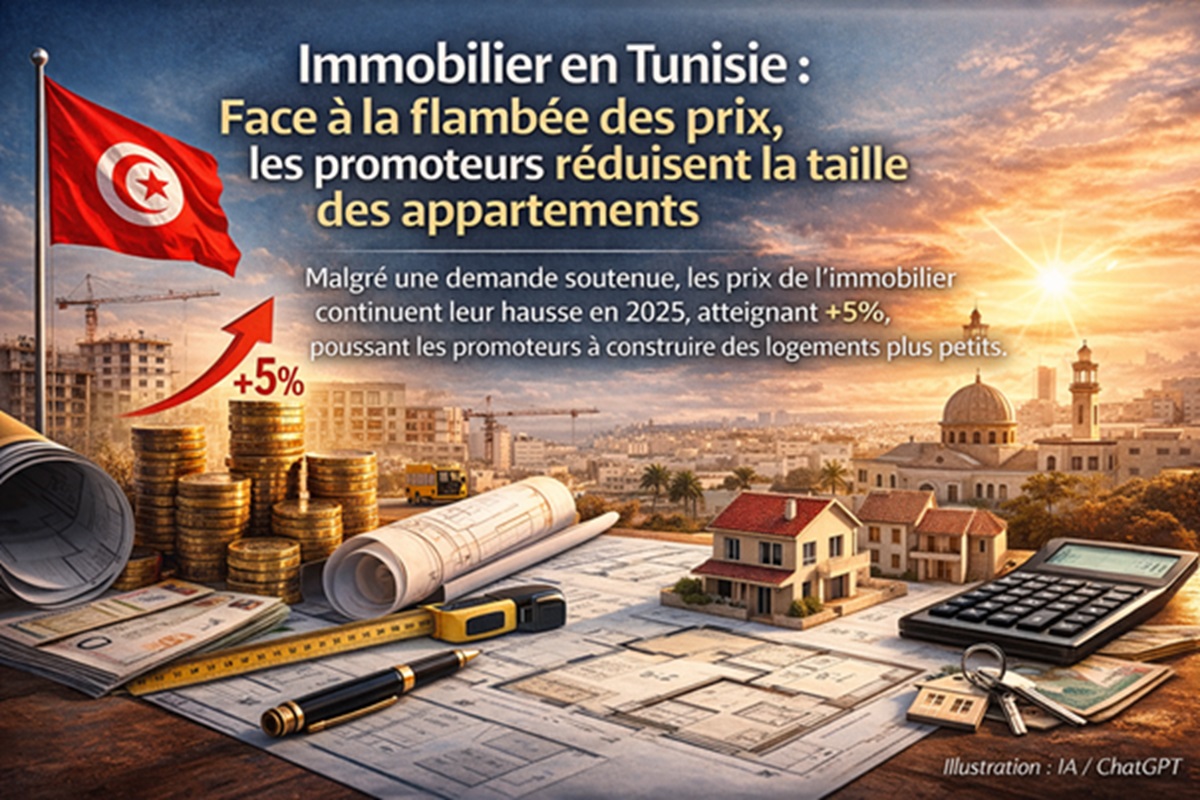
Tunisia’s real estate market continues to show an upward trend. In 2025, property sale prices increased by about 5% compared to 2024, according to data from the real estate platform Mubawab.
This development reflects both the sector’s structural pressures and the growing difficulties households face in accessing housing.
In an interview with African Manager, Anis Gharbi, director of the platform, explained that this increase is broadly in line with inflation. However, several factors continue to push prices upward, including the rising cost of construction materials, higher labor costs and the scarcity of available land.
The depreciation of the Tunisian dinar against the euro has also raised the cost of imported inputs.
Demand concentrated on S+2 apartments
Market data show that housing demand in Tunisia is mainly focused on S+2 apartments, which include a living room and two bedrooms. These units typically range between 90 and 120 square meters, making them the most sought-after option for Tunisian families.
At the same time, rents have also continued to rise. Rental prices for apartments, houses, and other real estate properties increased by around 5.25% in 2025 compared to the previous year.
Financing costs limit any price decline
For real estate developers, lowering prices remains difficult under current market conditions. Mortgage interest rates remain relatively high, limiting the ability of private developers to reduce selling prices.
“A real estate developer cannot sell at a loss,” Anis Gharbi emphasized. Like any business, developers must maintain profitability to ensure the continuity of their activities.
In this context, rising prices largely reflect the mechanical effect of increasing construction and financing costs.
A trend toward smaller housing units
Faced with these constraints, developers are gradually adopting a new strategy: reducing the size of housing units to keep prices more affordable.
While S+2 apartments traditionally ranged between 90 and 120 m², some projects now plan smaller units of 65 to 80 m². The goal is to limit price increases and preserve households’ purchasing power.
Hope for rent-to-own schemes
In this context, several sector stakeholders are placing their hopes in a “rent-to-own” mechanism, expected to be introduced soon in Tunisia.
Under this system, households will be able to access home ownership by paying monthly rent that will gradually be converted into repayment for the property.
Initially, the system will mainly involve public real estate developers, notably the Société de Promotion des Logements Sociaux (SPROLS) and the Société Nationale Immobilière de Tunisie (SNIT).
Authorities plan to build around 1,200 housing units by the end of the year, which could help ease demand pressure in certain areas.
For professionals in the sector, however, the effectiveness of the scheme will depend on extending it to the private sector.
Cooperation between the state and private developers could help build a larger number of homes at more affordable prices.
Homeownership remains a challenge for households
Despite strong demand, homeownership is becoming increasingly difficult for many Tunisian families.
One of the main obstacles is the down payment required by banks, usually set at 20% of the property price. With rising prices and declining purchasing power, many households can no longer afford this amount.
Some countries have eased such conditions by allowing households to borrow up to 120% of the property price, covering additional costs such as registration fees, notary fees, and administrative expenses.
Debate over vacant housing
The Tunisian real estate market is also marked by recurring debate about the number of vacant homes. Some estimates suggest nearly 800,000 unoccupied housing units in the country.
However, according to Anis Gharbi, this figure remains uncertain and requires further clarification. Moreover, even if part of the housing stock remains empty, it does not necessarily lead to lower prices.
One key reason lies in financing conditions. While mortgage rates in some countries range between 0.5% and 1%, Tunisian developers often face rates of 10% to 11%, which severely limits their ability to reduce prices.
Longer transaction procedures
Another notable development is the longer time needed to finalize property transactions. While purchases previously took about three months, procedures can now exceed six months.
This reflects both the increasing complexity of administrative procedures and the financial difficulties faced by households.
A sector searching for new solutions
To meet growing housing demand, several solutions have been proposed by industry professionals.
These include the creation of new cities and residential districts equipped with all necessary infrastructure, roads, schools, public transport, and social facilities.
Lowering interest rates on housing loans, for both households and developers, is also seen as a key lever to revive the market and improve access to housing.
In a country where owning a home remains a major aspiration for many families, balancing construction costs, financing conditions, and household purchasing power has become one of the main challenges facing Tunisia’s real estate sector.