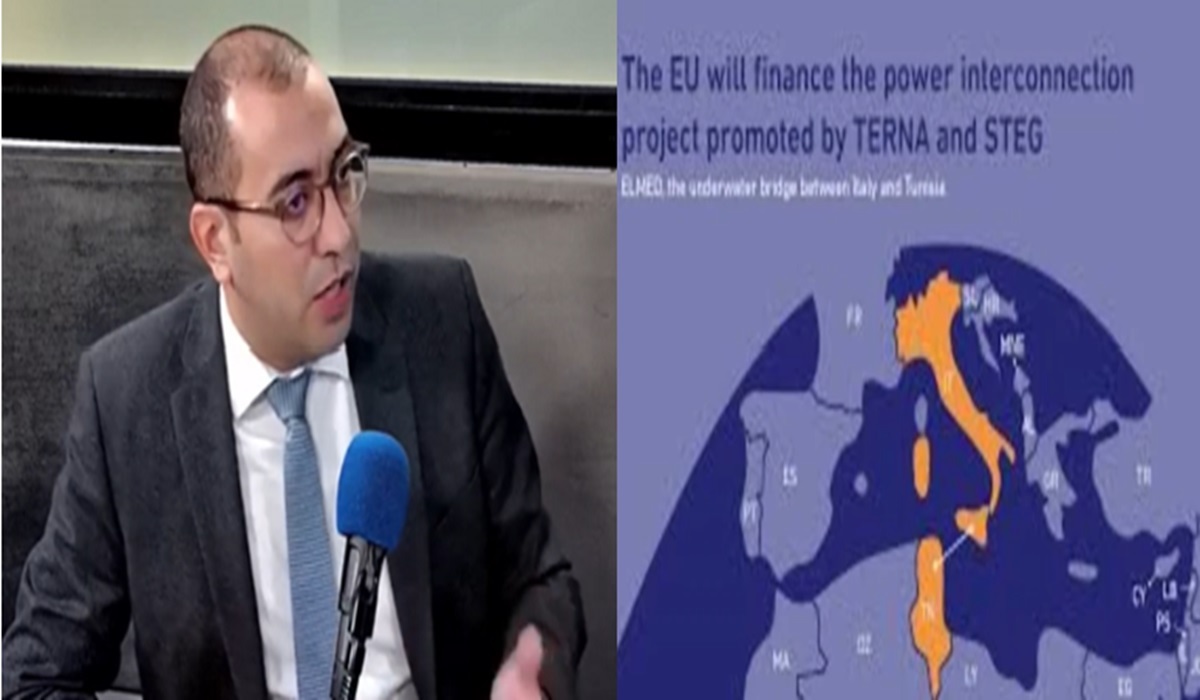
Tunisia’s Secretary of State for Energy Transition, Wael Chouchane, confirmed that the cost of the electricity interconnection with Italy, on the Tunisian side, is estimated at around €582 million (≈TND 1.967 billion).
The total project cost is estimated at €1.014 billion, including €863 million for shared components with Italy and approximately €110 million for strengthening Tunisia’s network.
Chouchane did not provide full details on how Tunisia will fund this major investment, which relies on loans from the World Bank, the EU, and KfW—loans that will eventually need to be repaid.
During a hearing before the Finance and Budget Committee of the Assembly of People’s Representatives (ARP), Chouchane revealed that project completion could be postponed to 2030 or 2031, not due to implementation difficulties, but because of strong international and regional pressures on infrastructure following the Russia-Ukraine war. This delay also pushes back the financial and economic benefits Tunisia expected from the interconnection project with Europe via Italy.
Details of a mega project for a country short of dinars
Chouchane described the Tunisian-Italian electricity interconnection as a strategic project to establish a direct energy bridge between Africa and Europe across the Mediterranean. The project involves a direct connection between the Tunisian and Italian grids via a 200 km high-voltage direct current (HVDC) submarine cable across the Strait of Sicily.
The cable will have a transport capacity of 600 MW at 500 kV and operate at a depth of about 800 meters. The interconnection will allow bidirectional electricity exchange based on demand, stabilizing the national grid and enhancing energy security.
The project also includes the construction of two transformer stations: one at Malabi (500/400 kV) and one at Partana (Sicily) (500/225 kV), along with the submarine cable, land connections, and monitoring and communication systems.
Additionally, the project will strengthen Tunisia’s electricity transmission network through the construction of 400 kV double-circuit overhead lines connecting Malabi to Grombalia 2, Grombalia 2 to Mornaguia, and Grombalia 2 to Kondar, as well as a new 400/225 kV transformer station at Grombalia 2.
Chouchane’s calculations: NPV of TND 12.4 billion and a return of 19%
He added that the cost-benefit analysis showed positive indicators, including a net present value of around 12.4 billion dinars, an interest-to-cost ratio of 4.5, and an internal rate of return of approximately 18.9%.
He specified that the annual revenues, ranging from €71 million to €182 million depending on the scenario, would be shared equally between the Tunisian Company of Electricity and Gas (STEG) and its Italian counterpart. Annual revenues, ranging from €71 million to €182 million depending on the scenario, would be shared equally between Tunisia’s STEG and its Italian counterpart.
Project financed by international loans that will eventually need to be repaid
Regarding the progress of the works, international tenders have been launched for the construction of transformer stations, the submarine cable, and overhead power lines. The preselection and evaluation of technical and financial bids have been completed, several contracts have already been signed and funding has been secured from the World Bank, the European Union, the European Bank for Reconstruction and Development, the European Investment Bank, and KfW.
The Secretary of State stressed the importance of the project for the energy transition and for strengthening Tunisia’s position as a regional energy hub between Africa and Europe, emphasizing the need to complete it within the planned timeframe, with transparency and good governance.
During his exchange with members of parliament, the Secretary of State also indicated that the project could be postponed until 2030 or 2031, not due to implementation difficulties but rather because of strong international and regional pressures on infrastructure since the Russia-Ukraine conflict.