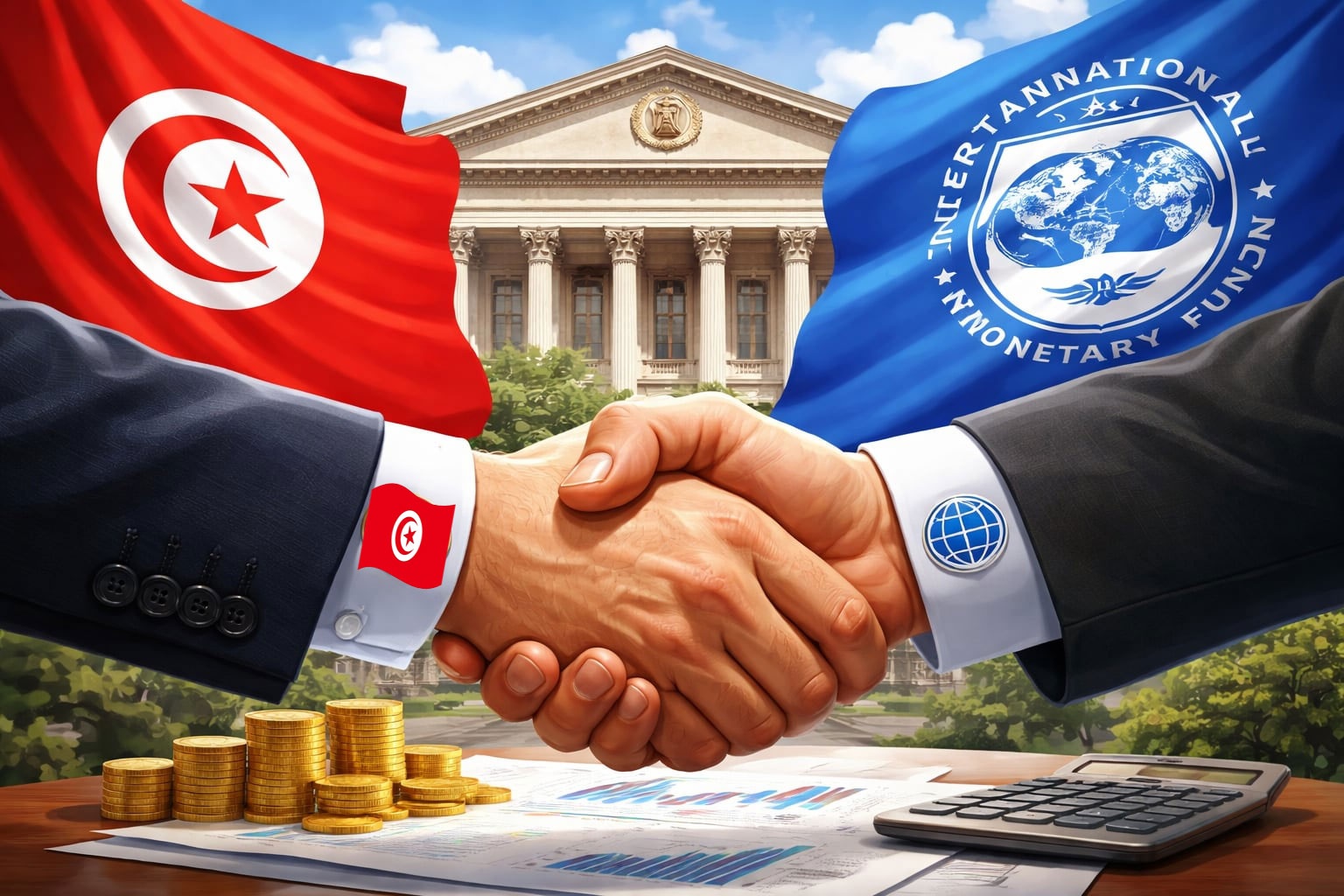
On the occasion of the 2026 Spring Meetings of the International Monetary Fund (IMF) and World Bank, Tunisia is presenting itself with an unprecedented stance. The country is no longer seeking a loan to “survive,” but a partnership to “rebound.” Between asserted sovereignty and budgetary necessities, it is charting a narrow path. Here’s an analysis:
As Tunisia’s economy navigates between sovereign resilience and structural fragilities at the start of 2026, its relationship with the International Monetary Fund appears frozen in a paradoxical status quo. Between the legitimate refusal of “diktats” and a persistent need for financing, what path remains for Tunisia?
This question arises within a newly darkened global landscape. As Kristalina Georgieva pointed out in her opening remarks on April 9, 2026, “the global economy, which has shown resilience, is once again being tested by a large-scale and asymmetric supply shock.”
For Tunisia, this shock translates into increased pressure on energy prices and regional instability, complicating any growth equation.
Since 2022, relations between Tunis and Washington have resembled a chess game where each player waits for the other to move a key piece. Neither a breakup nor a reconciliation, but a chilly cordiality.
On one side, an institution calling for deep structural reforms. On the other, a sovereign Tunisian state that places social stability as an untouchable red line, while gradually implementing some of the reforms proposed under the Bouden government. The situation could evolve.
According to the IMF’s Managing Director herself, “when we welcome ministers and central bank governors at our Spring Meetings, we will focus on how to overcome this new shock (editor’s note: ‘the war in the Middle East’) and make it less painful for both economies and populations. To do so, we must understand the nature of the shock, the channels through which it affects the economy, its magnitude, and the measures that can mitigate it.”
Resilience under pressure
In 2026, the time is no longer for a sudden rupture, but for a forced redefinition of the terms of engagement. To its credit, Tunisia shows remarkable resilience. Despite pessimistic forecasts in 2023–2024, the country avoided default, preserving its creditworthiness and keeping “vulture funds” at bay.
As of April 2026, foreign exchange reserves stand at around 101 days of imports, supported by strong tourism and significant remittances from the diaspora.
However, the debt wall remains imposing, with borrowing needs estimated at 27 billion dinars. Inflation, stabilized at around 5%, continues to weigh on purchasing power.
The IMF also warns that in this context of supply shocks, “demand adjustment is inevitable,” and authorities must ensure they do not “add fuel to the fire” through poorly targeted fiscal measures.
Short term: the “navigating by sight” scenario
The government is favoring an internal alternative by calling on the Central Bank of Tunisia to finance the budget, while multiplying bilateral agreements. While this decision-making autonomy allows reforms to be smoothed over time, it carries the risk of crowding out the private sector.
Georgieva was clear on this global point of vigilance, noting that “fiscal and monetary policies must not pull in opposite directions. That would be like driving with one foot on the accelerator and the other on the brake.”
For Tunis, the challenge is to prevent rent-seeking and the informal economy from thriving amid this strategic ambiguity.
Medium-term outlook: toward a “tailor-made agreement”?
By 2027, maintaining the status quo will become difficult without returning to international markets.
Two avenues are emerging. First, reform through results via the digitalization of social transfers to protect the most vulnerable without burdening the budget.
Second, the energy transition as a lever for negotiation. The IMF Managing Director reminds that although oil remains the main fuel, “the world has become increasingly energy efficient.”
By accelerating decarbonization, Tunisia could transform its financing needs into a “green transition,” a language the IMF now seems more willing to support financially.
Toward a high-road exit from the crisis?
To guide national reflection, three pillars stand out:
Reviving private investment: With foreign investors cooling off, simplifying the investment code is urgent.
Reforming public enterprises: Rather than politically rejected privatizations, performance contracts could prioritize efficiency over divestment.
Maintaining continuous technical dialogue: Sovereignty does not exclude cooperation. As the IMF states, “the strength and agility of your fundamentals are your best protection when shocks hit.”
Intensifying informal exchanges with the IMF could help prepare common ground based on inclusive growth while preserving the “Tunisian character” of public policies.
At the dawn of a new pragmatism?
Ultimately, Tunisia and the IMF seem destined to reach an understanding.
The country has proven it can stand on its own, defusing the rhetoric of absolute urgency. However, the suffocation of the private sector acts as a slow poison. True sovereignty will lie in Tunisia’s ability to impose its own reforms before the force of numbers does it for it.
The path is narrow, guided by a demand for national dignity which, combined with technical rigor, could transform this misunderstanding into a pragmatic partnership. Because ultimately, “good policies make the difference” and remain the only lasting shield against global uncertainty.
In her April 9 message, Kristalina Georgieva emphasized:
“While managing the lingering effects of the current shock, do not forget to steer major global transformations in technology, demography, geopolitics, trade, and climate, thereby building a better future. Your structural and regulatory policy choices underpin productivity and long-term growth—and growth potential matters greatly for stability.
Supporting you in building strong policies and institutions is the IMF’s core mission. But as a ‘firefighter,’ we are also there when crises arise (…) Given the repercussions of the war in the Middle East, we expect short-term demand for IMF balance-of-payments support to increase by $20 to $50 billion, with the lower bound assuming a ceasefire holds.
Two points are worth noting: first, this range would be much higher without the sound economic policies pursued over decades by many emerging countries. Second, we are well equipped to face this shock.
Thus, our 191-member countries can rely on us for financial support if needed. They can also rely on us to bring them together to find a path through the fog of uncertainty. That is what we will do next week.
Thank you for your attention. Let us hope for lasting peace in the Middle East and elsewhere, because war takes away everything we work for.”
The message was addressed to the international community, but it feels as though it was meant for Tunisia.