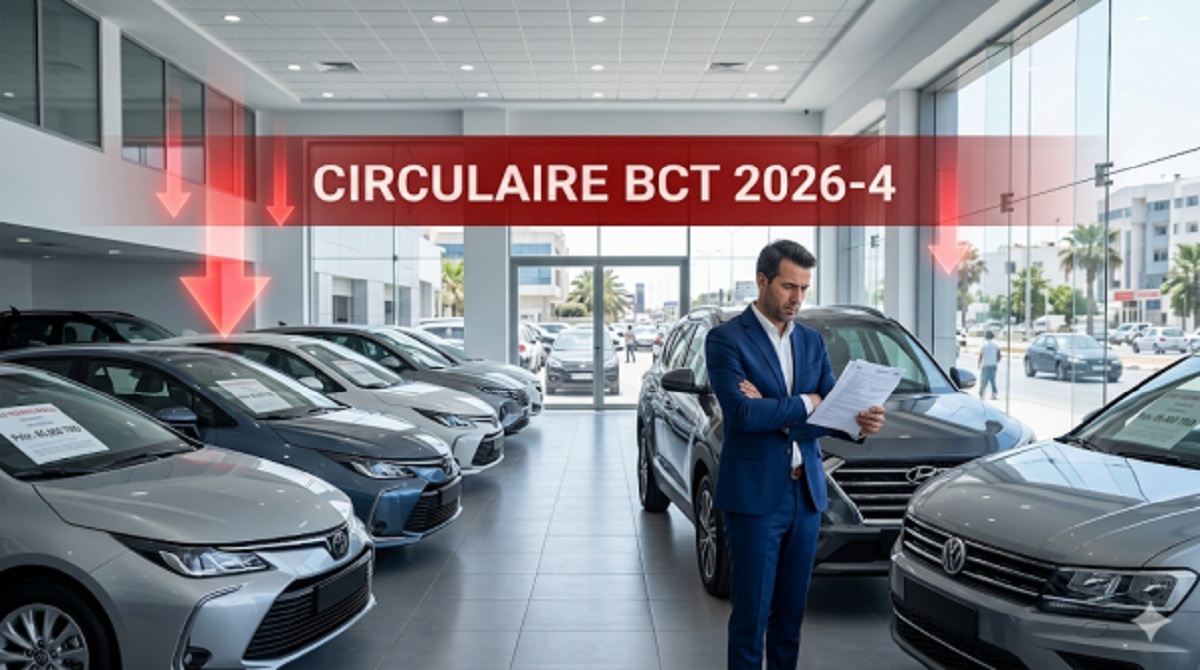
The inclusion of passenger cars in the list of non-priority products is the most structurally significant decision of BCT Circular No. 2026-4. For Tunisian dealers, it fundamentally alters the economics of their business, and for leasing companies, it could make operations even more difficult.
A growing market suddenly exposed
The Tunisian new passenger car market was strong in Jan-Feb 2026, with 8,889 registrations (+7.5% vs 2025). Hyundai led with 1,117 units (+35.7%), while Chinese brands now account for 22.5% of the market (2,003 units — a record).
Including 4,515 Grey Market re-registrations, total market volume reached 13,404 vehicles in two months.
It is on this expanding market that the BCT applied its 100% advance deposit rule. Chapter 8703 of the customs code (passenger cars and other vehicles mainly for people transport) is now at the top of the non-priority list, with no sector exemptions except for public contracts and previously committed orders.
The mechanism that blocks financing
About 70% of new vehicles are financed via bank credit. Dealers stock cars using bank credit lines (goods advances, import letters of credit). The BCT circular now requires that all financing, letters of credit, bank advances, guarantees, be backed by a 100% deposit of the vehicle value in equity. For an average monthly stock of 4,400 vehicles at 80,000 TND each, this means around 250–300 million TND must be immobilized before cars are even offloaded.
Two Tunisias in the dealership landscape
Large groups: vertically integrated, bank-backed, or part of solid conglomerates. For them, the 100% deposit is restrictive but manageable, requiring significant capital lock-up and slower supply.
Small & medium dealers: independent importers or secondary-brand agents with tight cash flow. For them, the rule effectively halts imports, as they cannot immobilize the required capital.
In both cases, the end consumer bears the cost, through higher car prices, including popular models, reducing accessibility for passenger and commercial vehicles — just as the tourist season begins, which could have benefited from regional demand.
The Grey Market paradox
The circular may accelerate the Grey Market. The 4,515 Jan-Feb 2026 re-registrations (33.7% of the total market) are vehicles already registered abroad and brought back under the resident abroad scheme. These are not considered imports and are exempt from the circular.
By making official new car imports harder and costlier, the BCT inadvertently gives a structural advantage to the Grey Market, which evades normal taxation, causing an estimated 215 million TND annual fiscal loss. If Grey Market share rises from 34% to 40% due to the circular, tax losses may outweigh foreign exchange savings.
In short, Circular 2026-4 risks disrupting Tunisia’s car market, limiting access to new vehicles, raising prices, and fueling untaxed Grey Market activity.
Chinese brands in a relatively strong position
The market structure creates a second distortion. Chinese brands like Chery, BAIC, Geely, and JAC account for 22.5% of the new car market in 2026, with unit prices structurally lower than European or Japanese brands.
A Chinese vehicle priced at TND 45,000–55,000 requires a pre-deposit roughly half that of a German or Japanese car costing TND 90,000–120,000. This measure therefore penalizes premium car importers more than entry-level importers, accelerating the ongoing “Chinese-ization” of the market.
What the circular does not say
The decision to include vehicles in the non-priority list comes without any support measures for dealers holding stock: no transitional pricing, no sectoral support mechanisms. It takes effect immediately. The automotive distribution sector, which directly employs tens of thousands and indirectly supports many more, must absorb this shock without a safety net.
The Central Bank has clearly prioritized preserving foreign currency reserves, a legitimate goal in the current context, over the continuity of distribution channels. This decision will create winners (well-capitalized groups, Grey Market importers, low-cost brands) and losers (small dealers, middle-income buyers, banks specializing in auto loans). Dealers are now forced to lock up hundreds of millions, sometimes up to 50% of annual turnover, while waiting 4–5 months for shipments from Asia.
Dealers remain silent
For now, dealers appear “too shocked” to react, either individually or through their trade association. “No comments. We need time to assess and understand the implementation,” one dealer told Africanmanager, requesting anonymity.
Leasing companies seem less concerned. One commented: “Large dealers have the cash to import vehicles. Many were using these funds in financial investments that still earn money. Small newcomers may struggle, but I don’t see a major impact. If your vehicles are in demand, you’ll manage to find the funds because they’ll be profitable.”